The False Sycamore of Mountain Forests
Characteristics
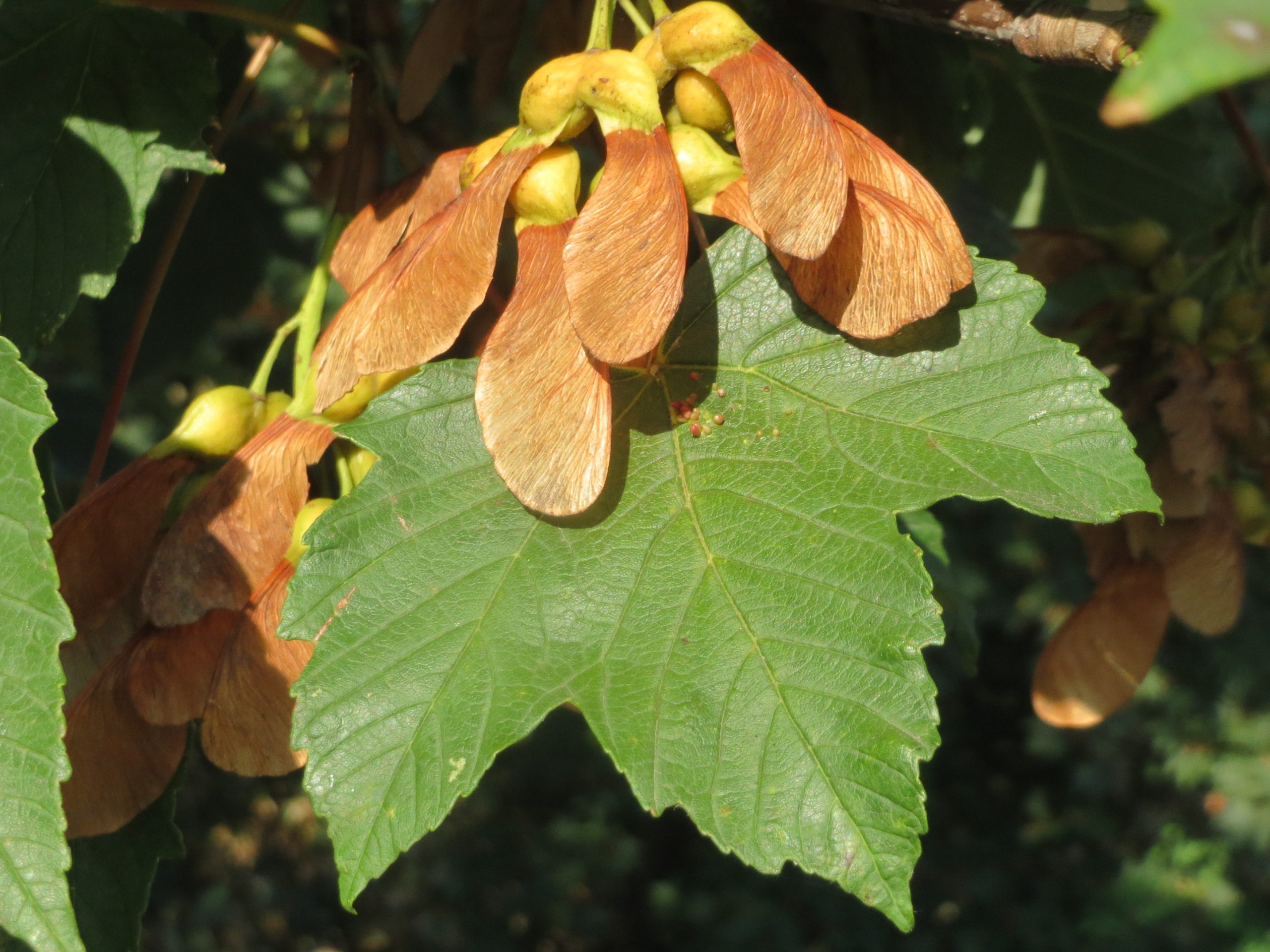
Habit: A tree up to 35 m tall, with a straight and sturdy trunk. Bark: Smooth and greyish when young, later fissured into thin plates revealing pinkish tones, reminiscent of plane tree bark. Leaves: Opposite, palmately lobed with five rather blunt lobes and a toothed margin, 10–15 cm across, dull green above and grey-green beneath; in autumn they turn golden yellow to warm orange. Flowers: Small, yellow-green, arranged in pendulous panicles. Fruits: A double samara, a dry fruit formed by two symmetrical samaras joined at the base, each consisting of a globose seed and a membranous wing. Flowering: March–May.
Distribution and habitat
Chorological type: European-Caucasian. Distribution in Italy: Widespread in almost all Italian regions, from the hilly belt to the montane zone. Habitat: It prefers cool forests on deep soils, between 400 and 1600 m above sea level.
Etymology
Generic name (Acer): From the Latin acer, acris, meaning “sharp” or “pointed”. Specific name (pseudoplatanus): Combines the Greek pseudos, “false”, and platanos, “plane tree”, in reference to the similarity of the leaves to those of the plane tree.
Uses and properties
Considered a highly melliferous plant, it is of great importance to beekeeping, while its sugary sap was historically collected to produce a fermented drink or used medicinally for its vitamin C content. Its homoxylous wood, compact and pale pinkish-white, is highly valued for furniture and flooring; in particular, the rare figured forms provide excellent resonance wood for violin making. Finally, although it is only a moderate fuel, it is frequently planted as an ornamental tree.