Achilles’ Thousand-Leaved Herb
Characteristics
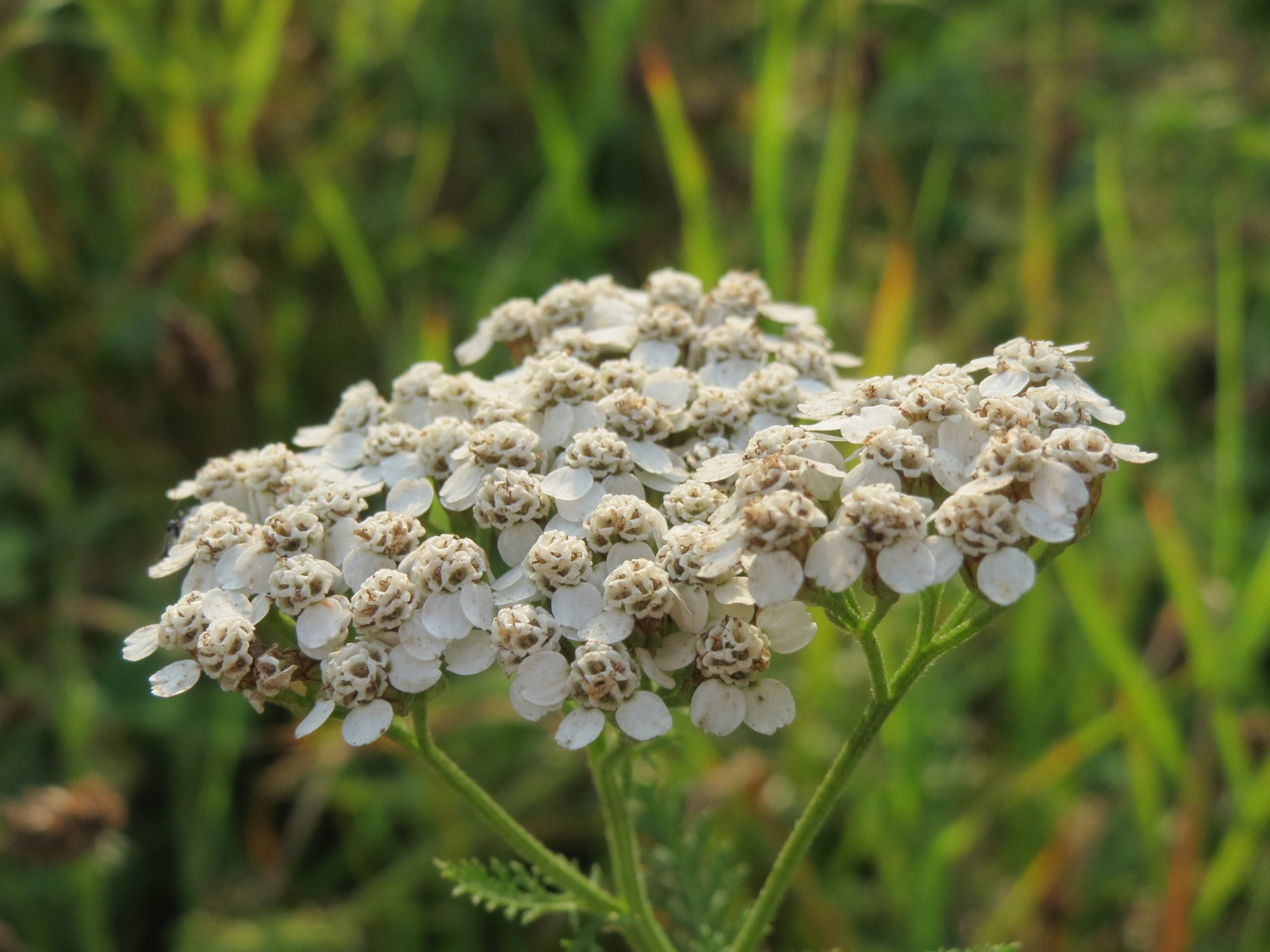
Habit: A perennial herb, rhizomatous and slightly suffruticose, 30–80 cm tall. Stem: Erect, pubescent and woolly, longitudinally striate, branched in the upper part. Leaves: Bipinnatisect, very finely divided, with numerous linear segments, 12–50 in number. Basal leaves lanceolate in outline; the lower surface is more or less covered with soft simple hairs. Flowers: Arranged in a dense, flat-topped compound corymb 4–5 cm across, with white, more rarely pinkish, ray florets having an almost square ligule with three blunt teeth, and white central tubular florets. Fruits: Compressed achenes, oval-oblong in shape, with a narrow wing. Flowering: April–September.
Distribution and habitat
Chorological type: Eurosiberian. Distribution in Italy: Present throughout Italy except in Puglia and Sicily. Habitat: Dry grasslands, uncultivated ground, and the margins of paths and hilly roads, from sea level to 2500 m above sea level.
Etymology
Generic name (Achillea): Derived from Achilles, the Greek hero who, according to Pliny the Elder, learned from Chiron to use this plant to heal the wounds of his companions, hence its reputation as a vulnerary. Specific name (millefolium): Refers to the numerous divisions of the leaves.
Uses and properties
Yarrow is known for its anti-haemorrhagic, stomachic, antispasmodic and eupeptic properties, making it a useful tonic for blood circulation. Internal use traditionally addressed bleeding, loss of appetite and digestive problems. In cosmetics it is employed in distilled form because of the presence of azulene, as a substitute for chamomile, while in food preparation it is used to make digestive liqueurs and was historically employed to improve wine preservation. Thanks to its hardiness, it is also widely cultivated as an ornamental plant for borders and flower beds.
Curiosities
In Ireland it was used to ward off the evil eye and disease. A Gaelic song celebrated its virtues of beauty and protection: “I will wound every man, but no man shall wound me.”