The Violet Eye of Rocky Peaks
Characteristics
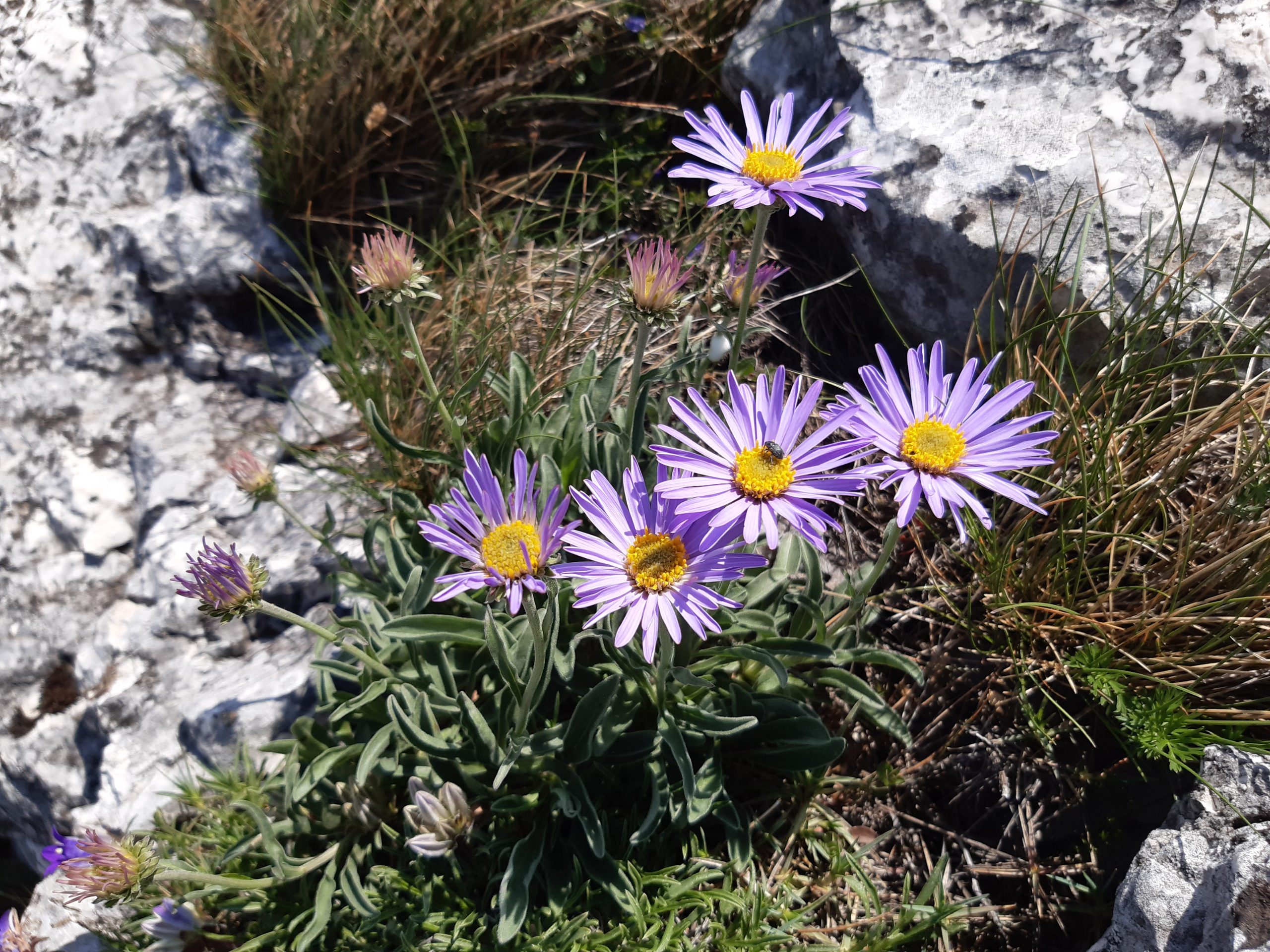
Habit: Small perennial herb, 6–15 cm tall. Stems: Woody and creeping, ending in a basal rosette and ascending cylindrical, pubescent scapes, characteristically swollen beneath the capitulum. Leaves: Basal leaves oblanceolate-spatulate with appressed pubescence, while the cauline leaves become progressively reduced upwards along the stem. Flowers: Arranged in a generally solitary flower head, 3–4 cm across, with a conical involucre; outer ray florets violet and showy, arranged radially, central tubular florets deep yellow. Fruits: Achenes provided with a yellowish pappus facilitating wind dispersal. Flowering: June–August.
Distribution and habitat
Chorological type: Circumboreal. Distribution in Italy: Present throughout the Alpine arc and in the central-northern Apennines. Habitat: It prefers alpine grasslands and rocky places between 1500 and 3000 m above sea level, though it may rarely descend to lower elevations.
Etymology
Generic name (Aster): From the Greek aster, “star”, clearly referring to the star-like form of the flower head. Specific name (alpinus): A Latin adjective indicating the species’ typically montane and alpine habitat.
Uses and properties
Thanks to its vivid flowering and hardiness, it is highly appreciated as an ornamental plant, especially in the design of high-altitude rock gardens and alpine flower beds.