The Slender Anther Head
Characteristics
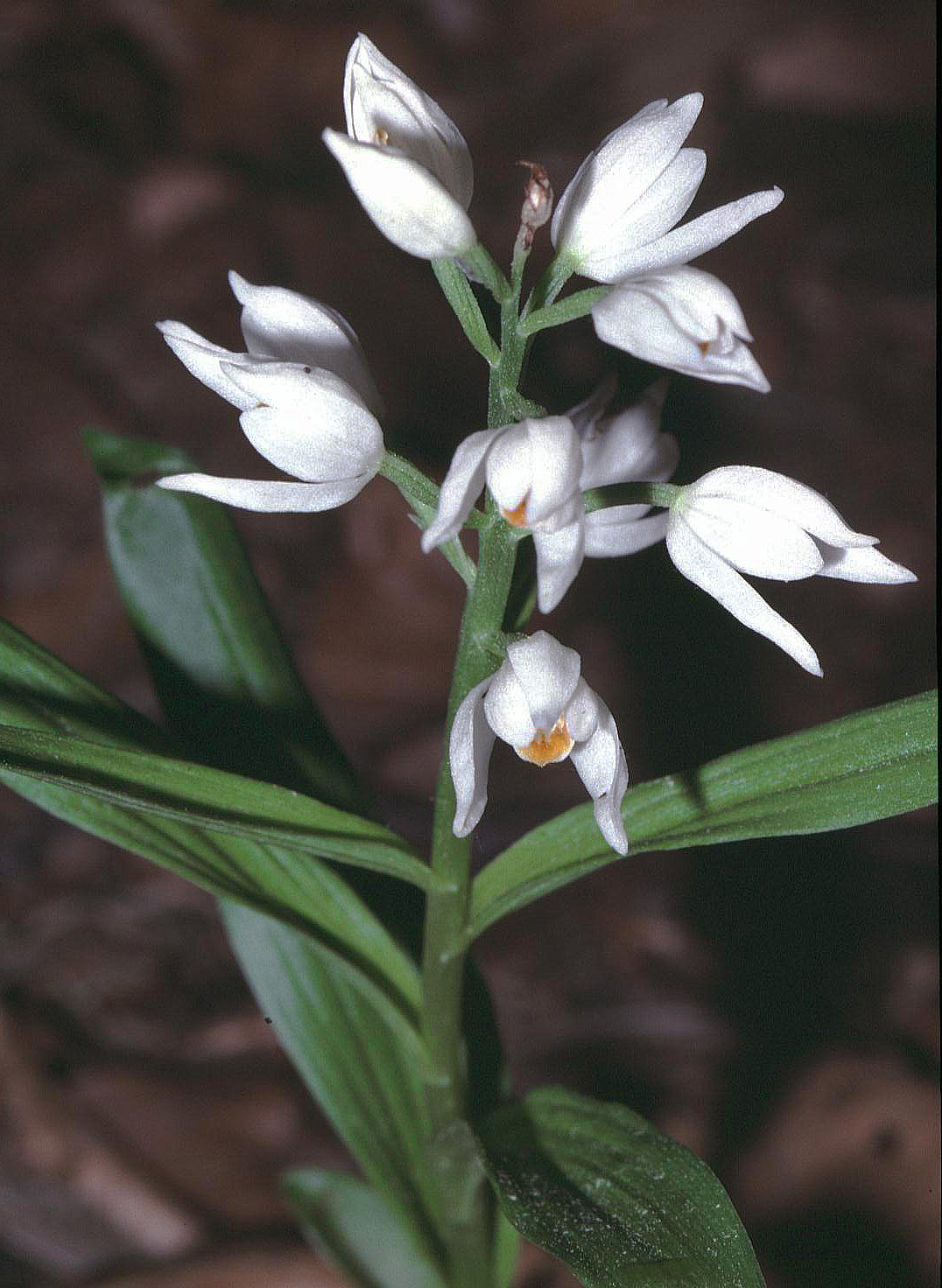
Habit: Slender perennial herb 15–60 cm tall, with a scaly rhizome. Stem: Erect, glabrous and sinuous, leafy up to the base of the inflorescence. Leaves: 6–10 in number, arranged alternately, very elongate linear-lanceolate, 10–15 cm long, with 5–9 evident veins and a length about ten times the width. Flowers: Arranged in a loose inflorescence with 10–20 pure white flowers, generally closed or half-closed, opening only in strong warmth and light. The lip is white with an orange patch at the throat, divided into a concave hypochile and epichile. Fruits: Erect capsules opening into three valves at maturity to release minute seeds. Flowering: March–July.
Distribution and habitat
Chorological type: Eurasian. Distribution in Italy: Uniformly present throughout the national territory. Habitat: A generally calcicolous and mesoxerophilous species; it prefers the half-shade of open woods, especially beech and oak woods, and clearings, from sea level up to 1800 m above sea level.
Etymology
Generic name (Cephalanthera): From the Greek kephale, “head”, and the Latin anthera, “anther”. The name refers to the position of the anther at the apex, “on the head”, of the column, the characteristic reproductive organ of orchids. Specific name (longifolia): Clearly of Latin origin, referring to the elongated and slender leaves, a distinctive trait compared with other species of the genus.
Uses and properties
Like all species of the Orchidaceae, narrow-leaved helleborine is fully protected throughout the national territory by the CITES Convention and regional laws, and its collection is strictly forbidden. Because it is partly mycoheterotrophic, living in symbiosis with root fungi, it is extremely vulnerable to soil disturbance and degradation of the woodland floor. Its presence is therefore an important indicator of the quality and integrity of forest ecosystems.
Curiosities
Come tutte le specie appartenenti alla famiglia delle Orchidaceae, la Cefalantera maggiore è protetta integralmente su tutto il territorio nazionale (Convenzione CITES e leggi regionali). La sua raccolta è severamente vietata. Essendo una pianta parzialmente micoeterotrofa (vive in simbiosi con funghi radicali), è estremamente vulnerabile alle alterazioni del suolo e alla degradazione del sottobosco. La sua presenza è un importante indicatore di qualità e integrità degli ecosistemi forestali.