The Soothing Benefactor
Characteristics
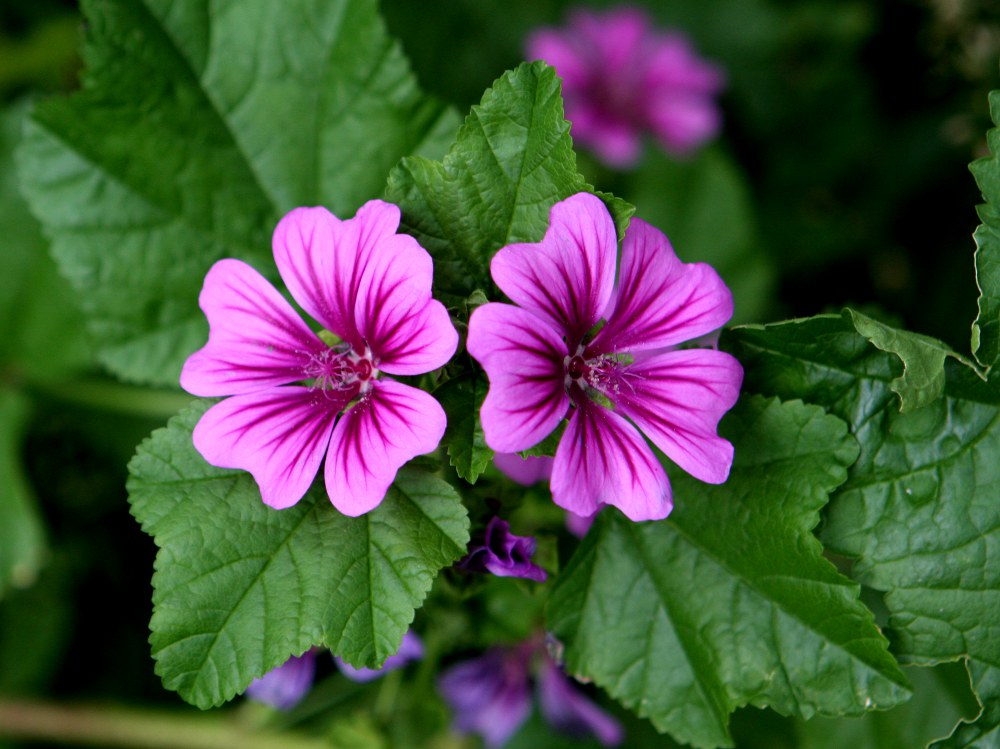
Habit: Herbaceous plant up to 1.50 m tall. Stems: Robust, striated, and bristly, tending to branch abundantly and becoming slightly woody at the base. Leaves: Alternate, with stipules and a pubescent pentalobed blade (divided into 5 lobes) with palmate venation. The margin is typically crenate (finely toothed). The basal leaves are gathered in a rosette and borne on a long petiole, while the upper leaves are progressively smaller. Flowers: Inserted in the axils of the cauline leaves, solitary or grouped in small clusters (2–6), borne on long peduncles. At the base of the calyx there is an epicalyx formed by 3 small bracts. The corolla, about 3–4 cm in diameter, consists of 5 bilobed pink-violet petals marked by three conspicuous darker longitudinal veins arising from the base. Fruits: A circular polyachene composed of numerous glabrous or pubescent mericarps arranged radially. Flowering: April–November.
Distribution and habitat
Chorological type: Subcosmopolitan. Distribution in Italy: Extremely common and widespread throughout the national territory, from the plains to mountainous areas. Habitat: Pioneer and ruderal species, thriving in uncultivated places, roadsides, meadows, cultivated fields, and near inhabited areas, from sea level up to 1600 m a.s.l.
Etymology
Generic name (Malva): The term recalls the Greek malátto (I soften) and malákhe (emollient), directly referring to the marked soothing properties of every part of the plant. Specific name (sylvestris): From the Latin sylvestris, meaning “wild” or “of the woods,” indicating its spontaneous nature.
Uses and properties
Common mallow has been considered a true “panacea” since antiquity; Pliny warmly recommended it, and in the Middle Ages it was called omnimorbia (a remedy for all ailments). Its main constituents are mucilages, which give the plant exceptional emollient and anti-inflammatory properties. For internal use, it is a remedy of choice against cough, gastritis, and inflammation of the mucous membranes. For external use, it is employed in compresses and eye lotions to soothe irritated skin, swollen gums, or conjunctivitis. In cooking, mallow is one of the most versatile wild herbs: the tender leaves can be eaten raw in salads or cooked in soups and fillings, while the unripe fruits are a crunchy edible snack. In cosmetics, it is used in toothpastes and soothing creams; the flowers were traditionally used to remove yellowish reflections from white hair.