The Poison Giant of Ditches
Characteristics
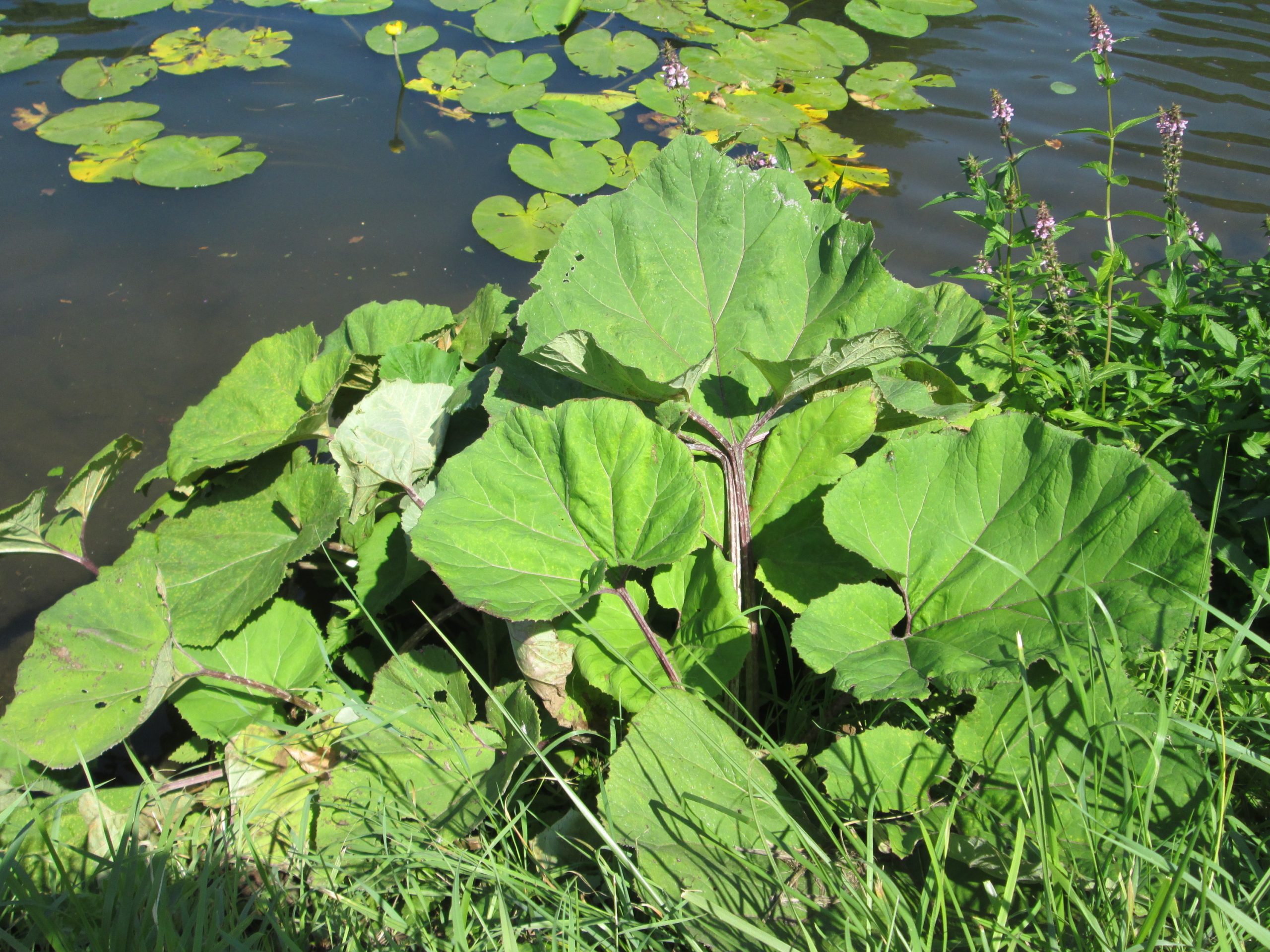
Habit: Perennial herbaceous plant developing from a robust, fleshy creeping rhizome. Stem: Erect, simple, and hollow, reddish in colour and covered with lanceolate scales of the same tone. During spring flowering it is about 50 cm tall, but it continues to elongate considerably during fruiting, and may exceed 120 cm. Leaves: They appear only after flowering and are among the largest in the European flora, reaching imposing dimensions (up to 80 × 40 cm). They are reniform or rounded, with an irregularly toothed margin. They are supported by a long grooved petiole, often tinged purplish, and have a slightly tomentose lower surface. Flowers: Gathered in pinkish-red capitula. The species is polygamous: the flowers are tubular and the plants may bear predominantly male or female heads (the latter generally larger). The bracts accompanying the inflorescence share the pinkish colour of the flowers. Fruits: A smooth, striated achene 2–3 mm long, topped by a conspicuous pappus of white bristles about 10 mm long, allowing wind dispersal. Flowering: February–May.
Distribution and habitat
Chorological type: Eurasian. Distribution in Italy: Present throughout the national territory, except Sardinia. Habitat: Found along the banks of watercourses, in ditches, wet meadows, and shady places, from sea level up to 1700 m a.s.l.
Etymology
Generic name (Petasites): From the Greek petàsos, the term for a broad-brimmed hat worn by travellers, clearly referring to the enormous size of the leaves, which could serve as shelter. Specific name (hybridus): From the Latin hybridus (hybrid), although the species is clearly defined and not hybrid in origin in the modern sense.
Uses and properties
Greater butterbur has a long history as an officinal plant. Its main constituents, including petasin, give it marked antispasmodic and analgesic properties, once making it a remedy of choice against asthma, whooping cough, and menstrual pain. Historically, its roots were even used against serious epidemics such as plague and cholera for their sudorific qualities. For external use, the fresh leaves were applied directly to sores and wounds to promote healing. Despite its medicinal virtues, domestic use is now strongly discouraged. The plant contains pyrrolizidine alkaloids that are severely hepatotoxic and potentially carcinogenic.