The Cortisone Bud of the Woods
Characteristics
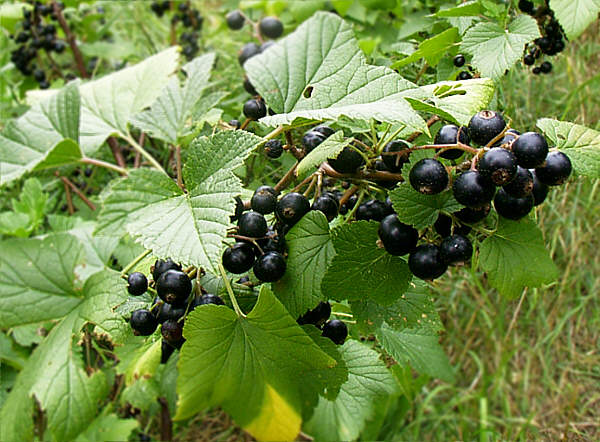
Habit: Deciduous perennial shrub with an erect, bushy habit, capable of reaching 2 metres in height. Branches: Slender, spineless, and much branched. Leaves: Alternate and palmately lobed, divided into 3–5 lobes with toothed margins and a cordate or rounded base. The upper surface is smooth, while the lower one is slightly tomentose and dotted with tiny sessile yellowish glands. These glands contain essential oils responsible for the plant’s characteristic pungent aroma. Flowers: Small, pentamerous, and pendulous, gathered in racemes 5–6 cm long. They are greenish-whitish outside and reddish inside. The receptacle is typically campanulate. Fruits: A globose berry that becomes intensely black-violet at maturity. Numerous small seeds are enclosed within the dark, juicy pulp. Flowering: June–July.
Distribution and habitat
Chorological type: Eurosiberian. Distribution in Italy: Considered a rare species in the wild, mainly found in some Alpine valleys, where it is often naturalised from old cultivations. Habitat: It grows in upper montane woods, preferring cool, moist places and humus-rich soils, between 500 and 1500 m a.s.l.
Etymology
Generic name (Ribes): From medieval Latin ribes, itself derived from the Arabic ribas, a term originally indicating a plant with a sour taste. Specific name (nigrum): From the Latin nigrum (black), referring to the dark, deep colour of the ripe berries.
Uses and properties
Blackcurrant is a cornerstone of modern herbal medicine. It is famous in gemmotherapy for its cortisone-like action: bud extracts stimulate the adrenal cortex to produce endogenous cortisol, acting as a powerful natural anti-inflammatory and antiallergic without the side effects of synthetic drugs. The fruits are extremely rich in vitamin C, anthocyanins, and polyphenols, which give them antioxidant properties and a protective action on the microcirculation. The berries are used to produce juices, jams, and syrups. In France, it is the essential ingredient of Crème de cassis, a renowned liqueur used to prepare the famous Kir aperitif. The oil extracted from the seeds is rich in essential fatty acids (gamma-linolenic acid), used in dermatology and cosmetics to regenerate the skin barrier and soothe sensitive skin.