The Guardian of Boundaries
Characteristics
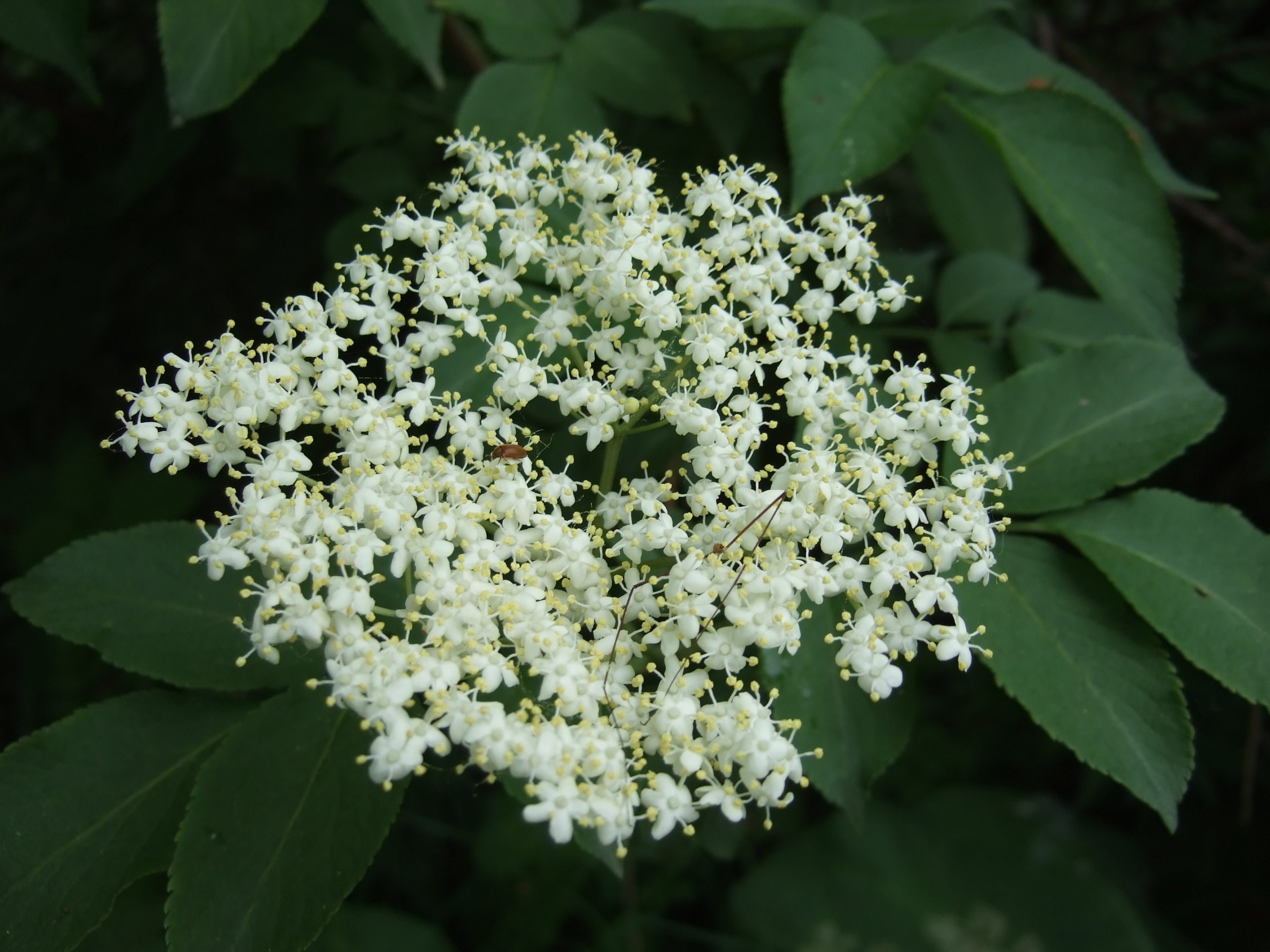
Habit: Shrub or small tree up to 10 metres tall, with an expanded and dense crown. Bark: Grey-brown, deeply fissured and rough. Branches: Young branches are grey, smooth, and dotted with lenticels. A distinctive feature is the central pith of the branches, white, soft, and elastic. Leaves: Deciduous, opposite, and odd-pinnate (20–30 cm long), composed of 5–7 ovate segments with an acuminate apex and toothed margin. When crushed, they give off an unpleasant smell that acts as a deterrent to many herbivores. Flowers: Gathered in a broad umbel-like corymb (up to 20 cm), erect during flowering and then bending downward with the weight of the fruits. The flowers are intensely fragrant, with an ivory-white corolla of 5 petals and yellow anthers. Fruits: Small globose drupes turning from green to glossy blackish-violet at maturity. They are gathered in pendulous infructescences borne on peduncles that become reddish. Flowering: April–June.
Distribution and habitat
Chorological type: European-Caucasian. Distribution in Italy: Common and present in all regions. Habitat: A heliophilous and nitrophilous species, it rapidly colonises clearings, margins of humid woods, embankments, and anthropised areas, from sea level up to 1400 m a.s.l.
Etymology
Generic name (Sambucus): Origin debated; some scholars link it to the Greek sambúke, a stringed musical instrument, probably made from its wood. Specific name (nigra): From the Latin niger (black), directly referring to the dark colour of the ripe berries.
Uses and properties
Black elder is a versatile medicinal and edible species. In traditional medicine, the flowers are used for their diaphoretic and emollient properties against respiratory ailments, while the fruits have a depurative and laxative action and are rich in Vitamins A and C. In cosmetics, flower lotions are used to soothe oily skin or sunburn. The flowers flavour wines and vinegars or are fried in batter; the fruits are transformed into syrups and jams, or used for the famous Sambuca. The juice of the berries is a powerful purple dye, while the leaves yield a green dye. The wood, hard and compact, is used for tool handles, while branches hollowed of their pith are used for blowpipes and whistles. All parts of the plant except the flowers and fully ripe fruits contain toxic cyanogenic glycosides.
Curiosities
Historically, elder was considered a “magical” plant: a protector against demons in paganism, the 13th month of the Celtic calendar, and the “guardian of the hearth” in Italian rural tradition. In the Middle Ages it was considered untouchable; cutting it down was regarded as an omen of misfortune.