The Yellow Star of the Rocks
Characteristics
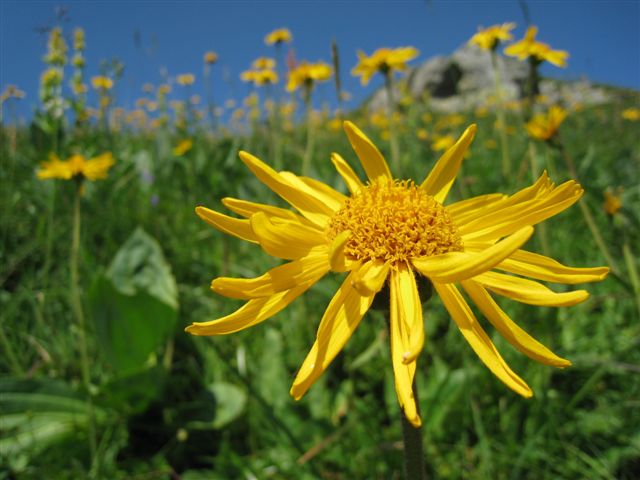
Habit: Robust perennial herbaceous plant, 20–70 cm tall. Stems: Erect, marked by longitudinal striations, and usually branched only in the upper portion, where they bear the showy capitula. Leaves: The basal leaves form a dense tuft; they are thick, dark green, petiolate, with a lanceolate-spatulate blade and a toothed margin. The cauline leaves are sessile, narrower, and become progressively scarcer upward along the stem. The lower surface is characterised by a slight whitish tomentum and a very pronounced midrib. Flowers: Arranged in an inflorescence of 1–3 large hemispherical capitula, 3.5–6 cm in diameter. The outer ligulate flowers are 12–20, of an intense orange-yellow, while the central tubular flowers form a yellow disc. The involucre is composed of linear scales reinforced by tomentose outer bracteoles with a characteristically blackish tip. Fruits: A glabrous, striated achene 5–6 mm long, surmounted by a white pappus 7–10 mm long that favours wind dispersal. Flowering: June–August.
Distribution and habitat
Chorological type: Southern European orophyte. Distribution in Italy: Present along the whole Alpine arc and the Apennine chain as far as Basilicata. Habitat: It grows in alpine pastures, dry meadows, screes, and rocky, sunny places, between 1300 and 2500 m a.s.l.
Etymology
Generic name (Senecio): From the Latin senex (old man). The name refers to the white pappus of the seeds, which recalls the beard or hair of an old person, or to the receptacle that, once the fruits are shed, appears naked and smooth like a bald head. Specific name (doronicum): Etymology debated. It may derive from the Arabic darawnay, the name of a similar plant, or from the Greek dóron (gift) and níke (victory), perhaps indicating a symbolic or medicinal value.
Curiosities
Like many other members of the genus Senecio, it may contain pyrrolizidine alkaloids, substances toxic to livestock if ingested in large quantities, which is why it is often avoided by grazing animals, favouring its persistence in mountain meadows.