The Wall Fern
Characteristics
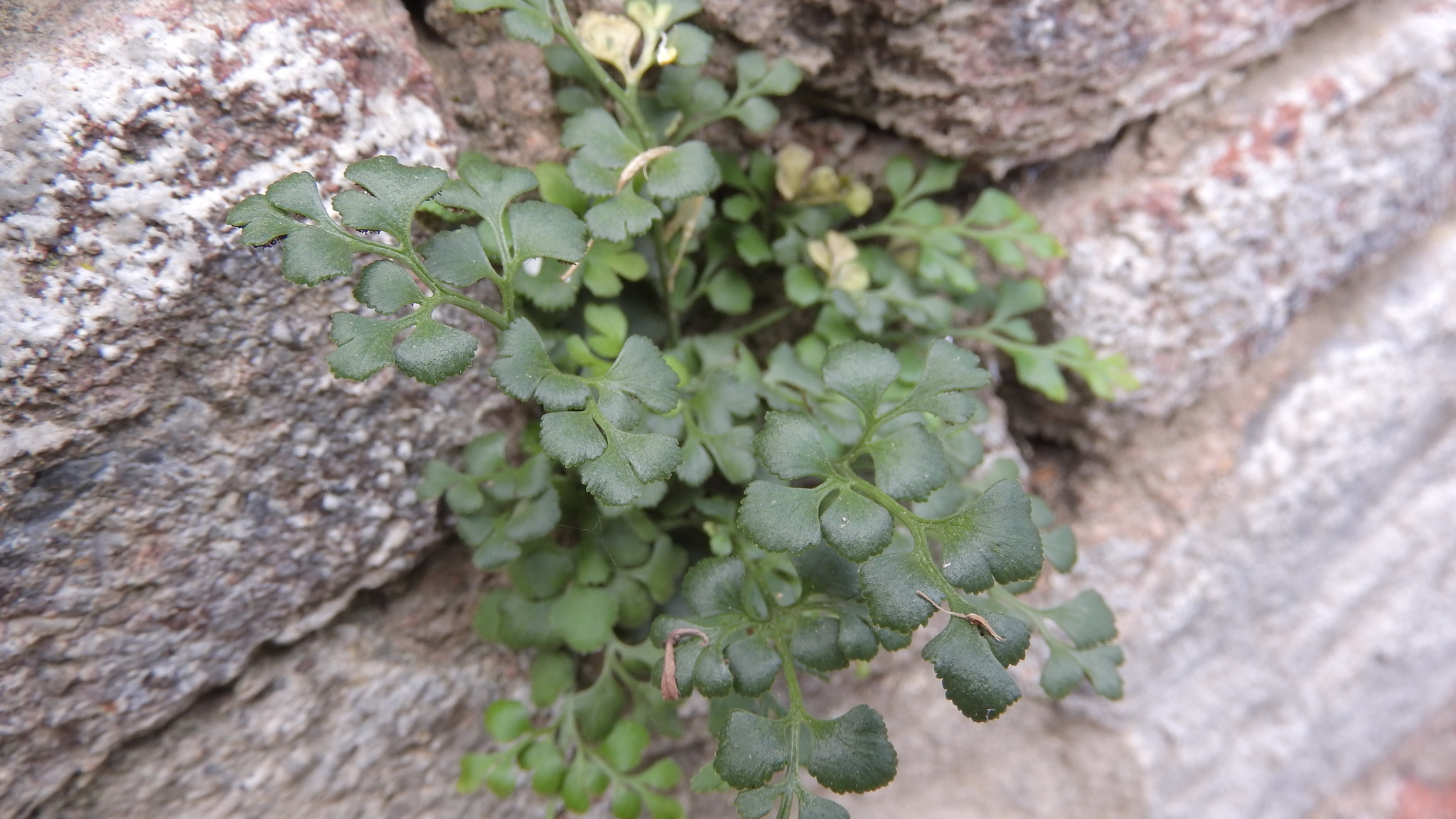
Habit: A glabrous perennial herb up to 15 cm tall, supported by a short, creeping, branched rhizomatous rootstock whose apex is covered with dark chestnut membranous scales. Fronds: Fascicled, with a green stipe, chestnut at the base, and a bipinnate, leathery, grey-green blade; segments composed of 2–5 pairs of petiolulate pinnules with denticulate margins and an irregularly rhomboid shape. Reproductive structures: Linear-elongate sori containing spores, initially separate and later confluent at maturity, almost entirely covering the underside of the pinnules. Sporulation: June–October.
Distribution and habitat
Chorological type: Circumboreal. Distribution in Italy: Present throughout the Italian territory, from coastal areas to mountain summits. Habitat: A typically rupicolous and wall-dwelling species, commonly growing on old walls and in fissures of calcareous rocks, from 0 to 2600 m above sea level.
Etymology
Generic name (Asplenium): From the Greek asplenos, a term used by Dioscorides and derived from the privative prefix a- and splen, “spleen”, because the plant was formerly believed to cure ailments related to that organ. Specific name (ruta-muraria): Composed of ruta, for the resemblance of the fronds to the leaves of Ruta, and muraria, from murarius, in reference to the wall habitat where it commonly grows.
Uses and properties
In ethnobotanical tradition, this small fern shares some of the properties associated with the genus Asplenium and was at times used in folk medicine for its expectorant and decongestant virtues. Although less well known than rustyback fern, it was used in the past in the preparation of cough syrups or decongestant poultices. Today the interest in the species is mainly botanical and ecological, owing to its ability to colonise extreme vertical habitats and historic masonry, thereby contributing to the biodiversity of human-shaped environments and natural rocky outcrops.