The Herb of Death and Beauty
Characteristics
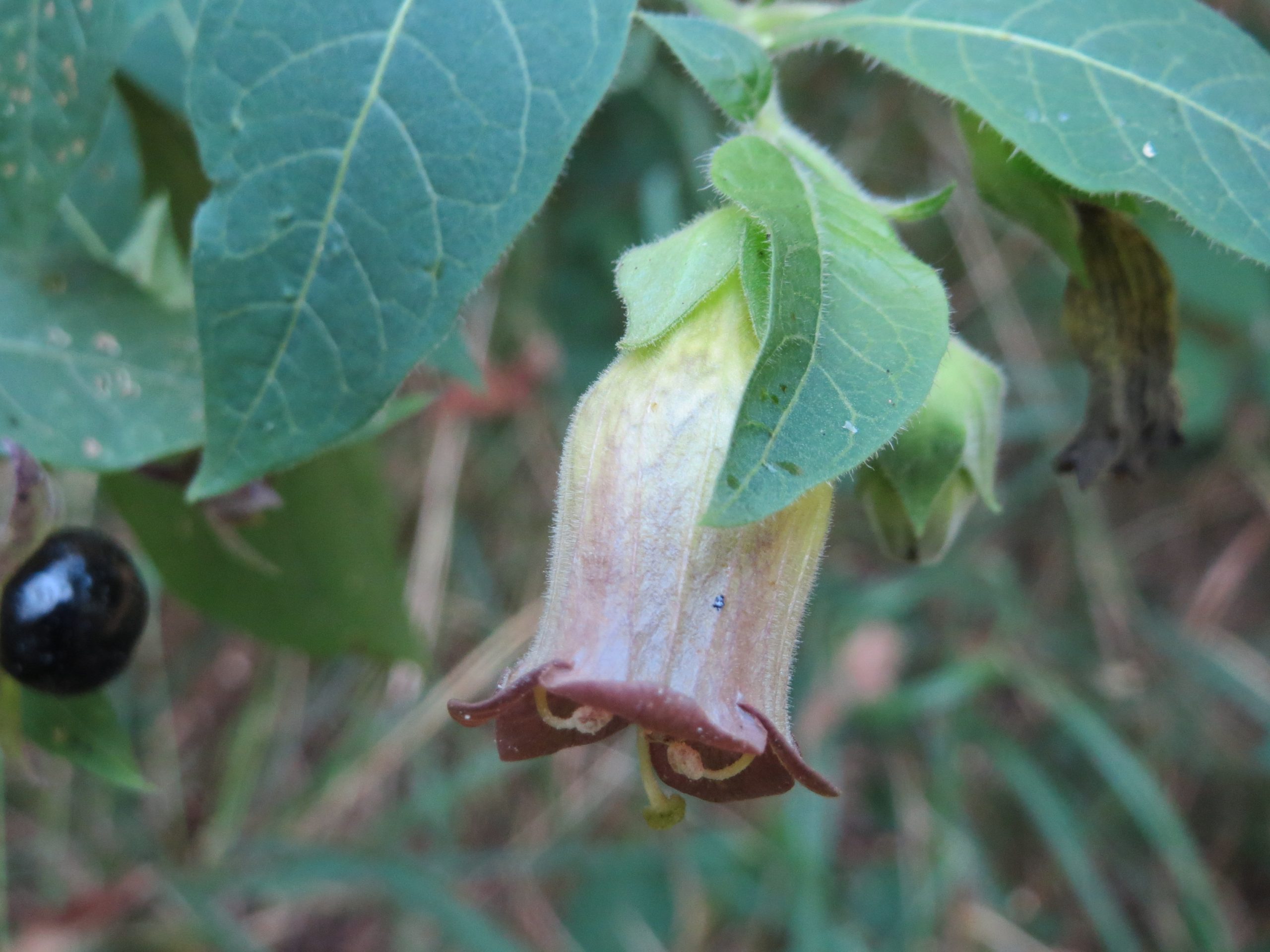
Habit: Perennial herb reaching 160–200 cm in height. Stems: Erect, finely striate, with widely spreading branches. Leaves: Petiolate, ovate-acuminate; alternate in the lower part of the stem, but paired on the same side in the upper part, with one leaf distinctly smaller than the other. Flowers: Solitary and pendulous, arising from the leaf axils on long peduncles; the corolla is bell-shaped, divided into five triangular lobes of purplish-violet with a greenish-white base. Fruits: Glossy spherical berries, changing from green to deep black at maturity, containing brownish kidney-shaped seeds with an alveolate surface. Flowering: June–September.
Distribution and habitat
Chorological type: Mediterranean montane. Distribution in Italy: Present throughout the national territory, although rather rare everywhere. Habitat: It grows in woods, clearings and path margins, preferring calcareous, sandy or clayey nutrient-rich soils, from lowland areas up to 1400 m above sea level.
Etymology
Generic name (Atropa): From the Greek Atropos, one of the three mythological Fates charged with cutting the thread of life, in allusion to the plant’s extreme toxicity. Specific name (belladonna): Refers to a Renaissance cosmetic use, when women used the juice to dilate the pupils, an effect then regarded as highly attractive.
Uses and properties
This medicinal species is extremely toxic because of the high content of tropane alkaloids, including hyoscyamine, atropine and scopolamine, in every part of the plant. In medicine, controlled doses of these substances are used as powerful antispasmodics, analgesics and antidotes for poisoning by nerve agents or mushrooms, as well as in the treatment of Parkinson’s disease and as pre-anaesthetic agents. For external use, belladonna extracts were once included in ointments to relieve rheumatic and muscular pain.
Curiosities
In the Middle Ages, belladonna was a key ingredient of the so-called “witches’ ointment”, used to induce a state of unconsciousness before surgical procedures or to generate powerful hallucinations during rituals linked to witchcraft, the so-called “psychic journeys”. In 1960, the scholar Will-Erich Peukert scientifically demonstrated these properties by applying an ancient recipe and experiencing a deep twenty-hour sleep accompanied by visions. Even today, in popular speech, the expression “rubbing oneself with belladonna” is used ironically for those who complain excessively about minor aches and pains.