The Sleeping Serpent of Walls
Characteristics
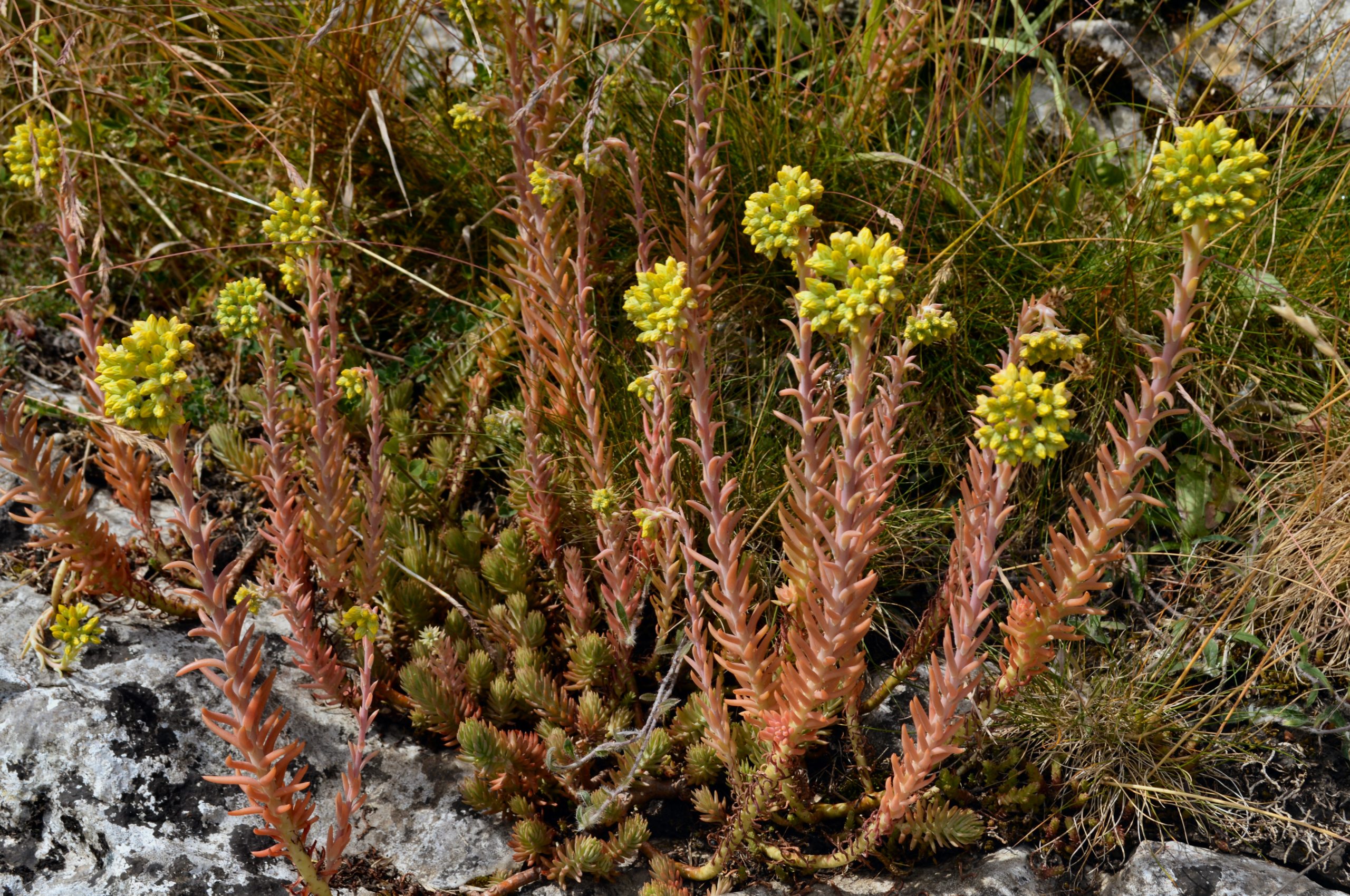
Habit: Perennial herbaceous, succulent, and completely glabrous plant. It has a suffruticose structure, that is, slightly woody at the base, and reaches a height of 15 to 30 cm. Stems: Sterile stems are shorter (3–8 cm), densely covered with imbricate leaves and with very short internodes. Fertile stems are longer, ascending, with well-defined internodes and show a characteristic curvature of the scape before flowering. Leaves: Alternate, fleshy, and cylindrical-linear in shape. They are acute, usually mucronate, and prolonged at the base into a short spur partially clasping the stem. Flowers: Gathered in a corymbose inflorescence provided with bracts and slightly concave, with branches tending to curve outward. The flowers are hermaphroditic, actinomorphic, and generally 5-merous, although 6-petalled variants may occur. The calyx has green, fleshy sepals, while the corolla is formed by free bright yellow petals (6–7 mm), acute and spreading, often striated on the back. Fruits: A follicetum, that is, a group of fusiform, more or less erect follicles that retain the persistent styles at the apex even after ripening. Flowering: April–July.
Distribution and habitat
Chorological type: Central European. Distribution in Italy: Present in much of the Italian territory, with a rather widespread distribution in the peninsular regions. Habitat: A typically pioneer species, it grows in difficult environments such as dry-stone walls, cliffs, rocky places, and dry grasslands, from sea level up to 1200 m a.s.l.
Etymology
Generic name (Petrosedum): Derived from the combination of the Greek pétra (rock, stone) and the Latin sédo (I sit or I soothe). The reference is twofold: to the habit of the plant, which seems to “sit” on rocks, and to the ancient use of its succulent leaves to soothe the pain of wounds and inflammations. Specific name (rupestre): From the Latin rupestris, clearly indicating the ecology of the species, inseparably linked to rocky and stony habitats.
Uses and properties
In some local culinary traditions, the young leaves of rock stonecrop (provided they are not too sharply pointed) were eaten in salads for their slightly sour taste, although today it is appreciated mainly as an ornamental plant for rock gardens and green roofs, thanks to its extraordinary drought resistance and its ability to stabilise walls and embankments.