Jupiter’s Curled Helm
Characteristics
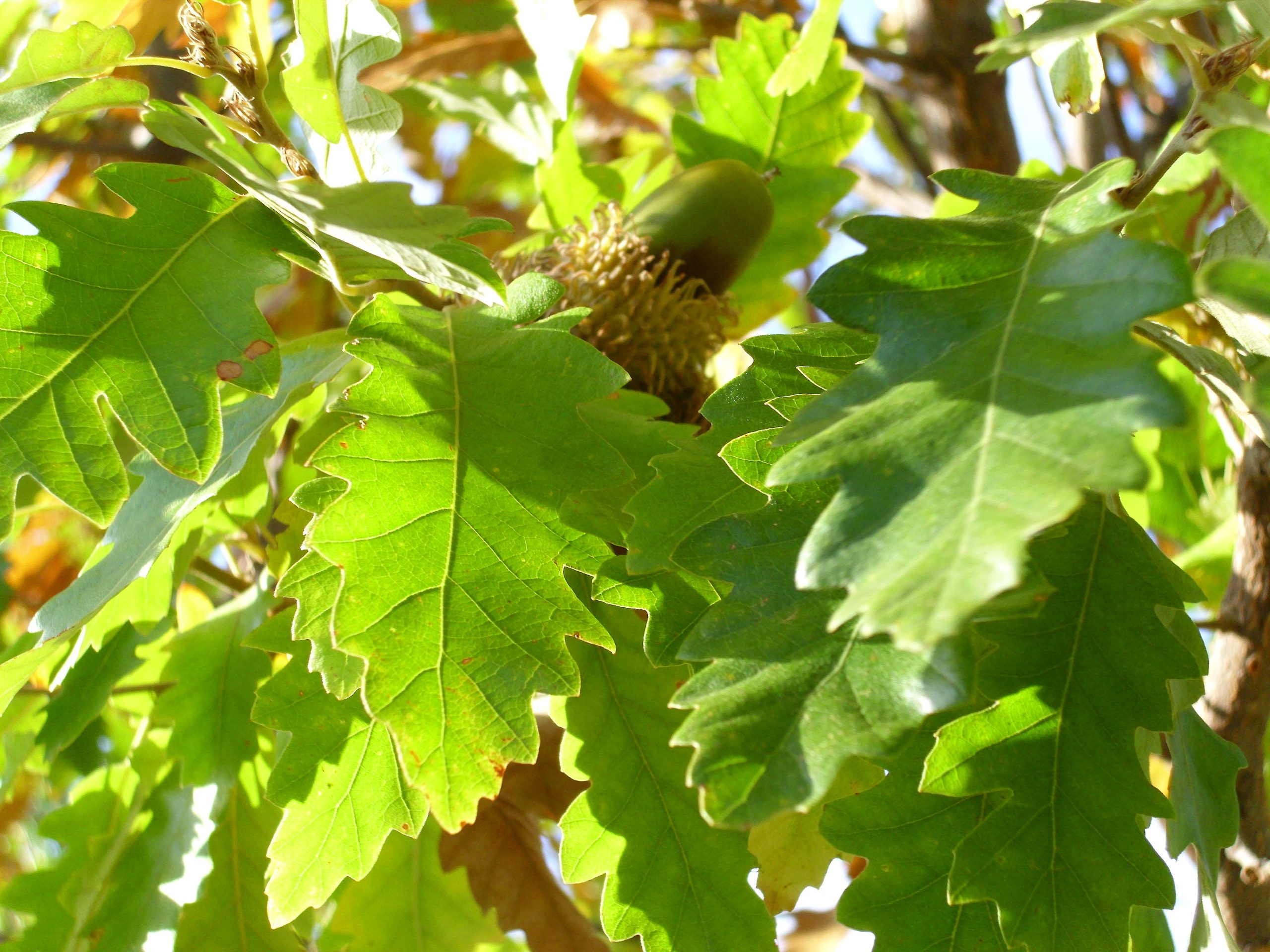
Habit: Large deciduous tree, majestic and slender, with a straight, regular trunk, capable of reaching 35–40 metres in height. Bark: Grey-brown with deep furrows revealing a reddish background (phelloderm), allowing it to be easily distinguished from other oaks. Leaves: Alternate and late-deciduous, showing marked morphological variability (heterophylly). In general they are obovate-oblong with 7–9 pairs of unequal, deep lobes. Their texture is leathery, with a dark green upper surface and a paler, slightly pubescent lower one. Flowers: Monoecious species with unisexual flowers on the same plant. The male flowers are gathered in loose, pendulous catkins 6–8 cm long; the female ones are solitary or grouped in small clusters (2–3), borne on short peduncles. Fruits: Acorn about 2.5 cm long. The cupule is entirely covered by elongated, recurved scales, like a curly yellowish tuft, which gives it a bristly appearance. Flowering: April–May.
Distribution and habitat
Chorological type: Northern Eurymediterranean. Distribution in Italy: Very widespread throughout the territory, especially along the Apennine chain where it forms extensive pure or mixed woods. Habitat: Ecologically intermediate between mesophilous hill woods and montane beech forests. Although it prefers volcanic, slightly acidic soils, it shows great adaptability, growing also on clayey, calcareous, or decalcified soils, from sea level up to 1300 m a.s.l.
Etymology
Generic name (Quercus): Classical Latin term designating the oak, a tree sacred to Jupiter and a symbol of strength. Specific name (cerris): Derived from the vernacular name cerro, already in use in the time of Pliny the Elder to distinguish this specific kind of oak.
Uses and properties
Turkey oak is widely used in Mediterranean reforestation because of its faster growth compared with other oaks. Historically, its timber was fundamental for the production of railway sleepers, barrel staves, and cart-wheel spokes. Today, although it is also used for indoor furniture, its main destination is as an excellent fuel and for the production of high-quality charcoal. From the medicinal point of view, the bark and acorns are rich in tannins, which give the plant marked astringent properties. A historical curiosity comes from Pliny the Elder, who in his Naturalis Historia claimed that the roots of the Turkey oak had a natural repellent action against scorpions.