The Silver Lace of Limestone Cliffs
Characteristics
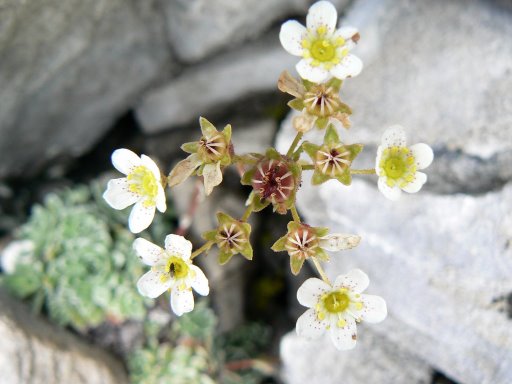
Habit: Perennial tufted herbaceous plant, 5–50 cm tall. Stem: Erect, partly woody at the base, leafy in the lower part, and branched above to bear the flowers. Leaves: Arranged in persistent rosettes, sessile, succulent, and leathery. Their shape is oblong-spatulate (2–5 cm). The distinctive feature is the margin: it bears incurved teeth and visible calcium carbonate secretions on the upper surface, giving the plant its typical mealy or encrusted appearance. Flowers: Gathered in an inflorescence composed of lax racemes arranged in small panicles. The flowers are about 10 mm wide, with a glabrous calyx of 5 triangular sepals. The corolla is formed by 5 white or whitish-yellow petals, often decorated with tiny red dots. Fruits: A globose septicidal capsule containing numerous fusiform seeds adapted for dispersal among rocky crevices. Flowering: May–August.
Distribution and habitat
Chorological type: Arctic-Alpine / Euro-American. Distribution in Italy: Widespread along the whole Alpine arc and the Apennine chain. Habitat: It colonises crevices of cliffs, exposed rocks, screes, and consolidated gravels, preferring calcareous or dolomitic substrates, from 400 up to 3000 m a.s.l.
Etymology
Generic name (Saxifraga): From the Latin saxum (rock) and frango (to break), alluding either to the plant’s ability to crumble rock with its roots or to its ancient medicinal use for “breaking” kidney stones. Specific name (paniculata): From the Latin paniculatus (paniculate), referring to the branched structure of the inflorescence.
Curiosities
Despite its wide distribution, it is considered a species of notable floristic value and is subject to strict regional protection in several areas of Italy (Lombardy, Veneto, Trentino-Alto Adige, Campania, and Calabria). Collection is prohibited or regulated in order to preserve the integrity of rocky ecosystems.