The Ashen Anti-Lightning Cushion
Characteristics
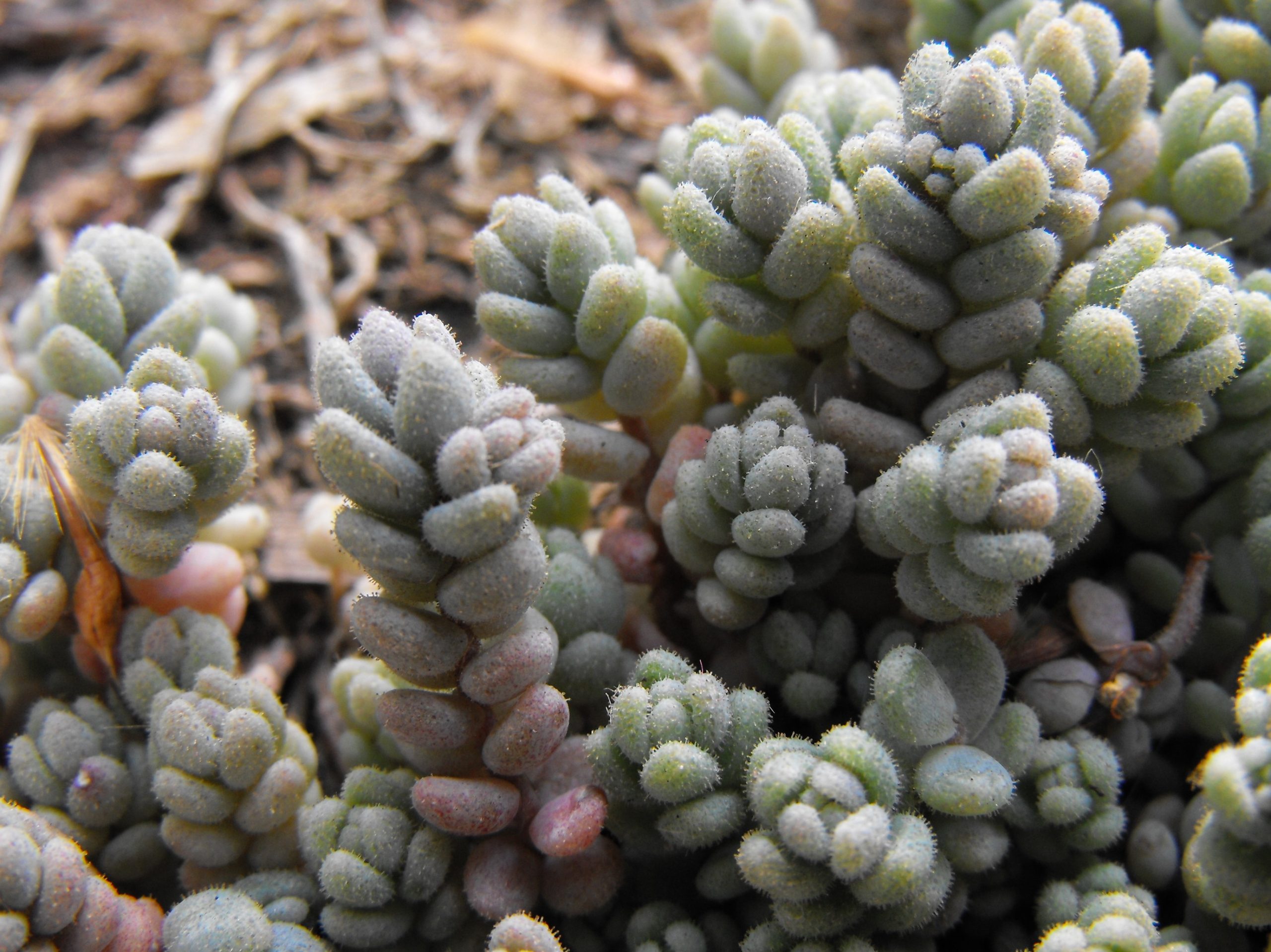
Habit: Small perennial herbaceous plant developing in dense, succulent, tufted cushions, 2–15 cm tall. Stems: Slender, woody at the base, with a creeping habit and the ability to root at the nodes, which allows the plant to spread horizontally across rocky surfaces. Leaves: Very small (3–5 mm), extremely fleshy, and ovoid-suborbicular in shape. They are gibbous at the base, laterally swollen, and plano-convex. Their arrangement varies: on sterile stems they are tightly imbricate, while on flowering stems they appear opposite and more spaced. Flowers: Star-shaped, gathered in small few-flowered cymes borne on pubescent peduncles. The corolla is composed of 5–6 lanceolate petals, 4–5 mm long, whitish-yellow or whitish-pink, with a distinct dark purple or violet central vein visible on the outer surface. Fruits: A follicetum composed of 5–6 yellowish-green follicles, erect and pointed, retaining the persistent style at the apex. Flowering: April–July.
Distribution and habitat
Chorological type: Eurymediterranean. Distribution in Italy: Common and present in all regions, from the coasts to the mountains. Habitat: It grows on dry-stone walls, cliffs, rocky places, and screes, showing a preference for siliceous substrates, from sea level up to 1800 m a.s.l.
Etymology
Generic name (Sedum): From the Latin sedeo (I sit), referring to the plant’s habit of clinging and “sitting” on rocks, or from sedare (to soothe), for the soothing properties of the succulent tissues. Specific name (dasyphyllum): Composed of the Greek words dasýs (hairy, dense) and phýllon (leaf), referring to the dense glandular hairiness covering the foliage.
Uses and properties
According to an ancient folk belief, shared with other Crassulaceae such as Sempervivum, thick-leaved stonecrop possesses the power to protect dwellings from lightning and fire. For this reason, its growth was historically encouraged on roofs and on the tops of the perimeter walls of rural houses as a kind of “vegetal lightning rod.”