The Liver Shield and the Virgin’s Milk
Characteristics
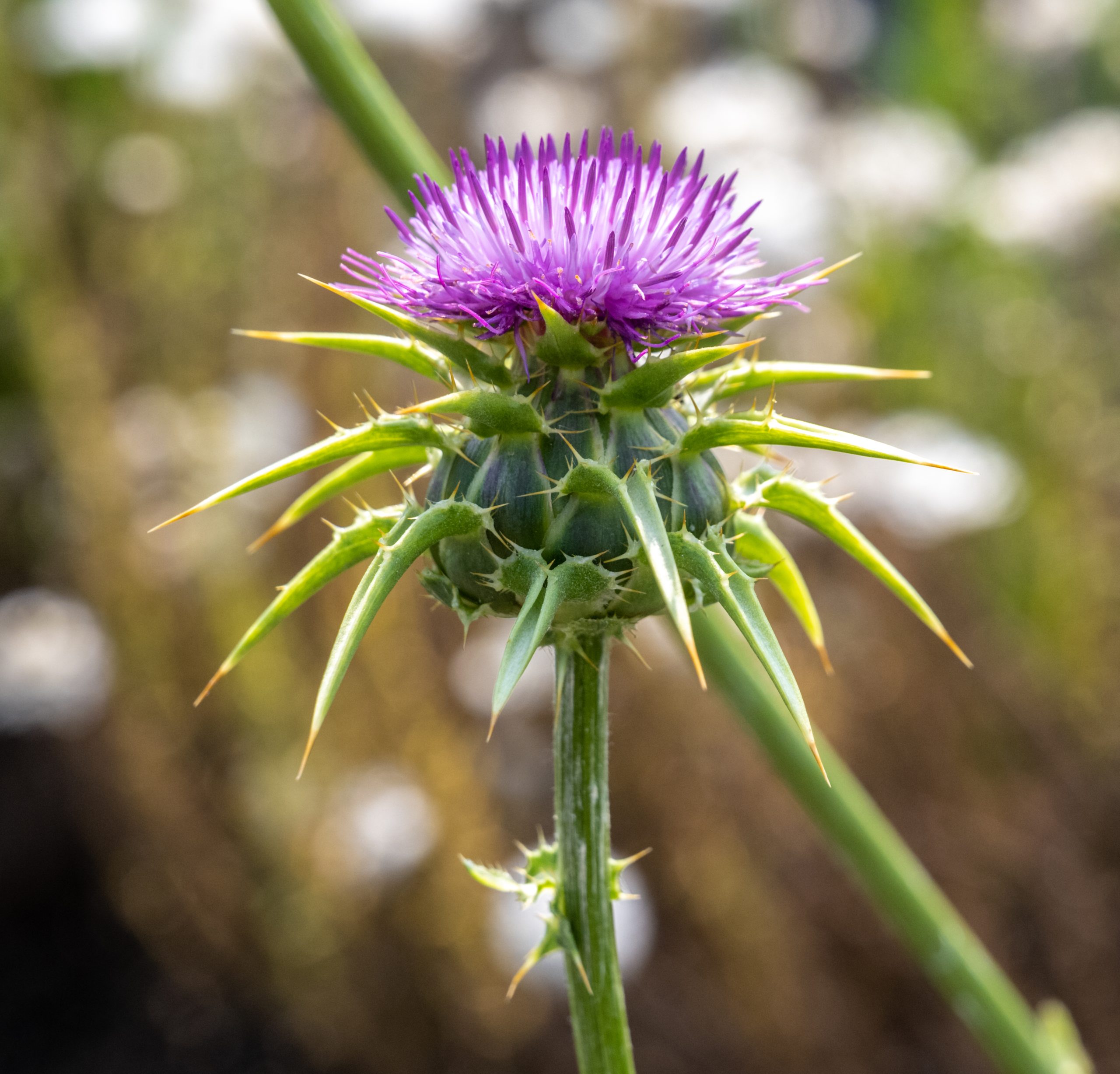
Habit: Robust and spiny herbaceous plant, 30–150 cm tall. Stem: Erect, longitudinally striated, branched in the upper part, and lacking spiny wings, unlike other thistles. Leaves: They show marked dimorphism along the stem. The basal ones are very large, up to 40 cm, petiolate, pinnatifid, and leathery, with undulate margins protected by strong yellow spines. The blade is dark glossy green, interrupted by a conspicuous white marbled variegation along the veins, caused by air spaces between the tissues. Flowers: Gathered in large, solitary, globose capitula. The involucre is composed of leathery bracts ending in a strong recurved apical spine. The flowers are all tubular, of an intense purple colour, rarely white. Fruits: A black, glossy, oblong achene, furnished with a silky white pappus that facilitates dispersal and falls off easily at maturity. Flowering: May–August.
Distribution and habitat
Chorological type: Mediterranean-Turanian. Distribution in Italy: Widely distributed throughout the national territory, from the islands to the pre-Alpine areas. Habitat: A ruderal plant preferring uncultivated land, roadsides, ruins, and degraded pastures. It is commonly found from the lowlands up to 1000 m a.s.l., often as a relic of old vegetable or monastic cultivations.
Etymology
Generic name (Silybum): From the Greek silybon, a term used by Dioscorides to describe various edible thistle species. Specific name (marianum): Linked to a Christian tradition according to which the white blotches on the leaves were caused by drops of milk falling from the breast of the Virgin Mary while nursing Jesus during the Flight into Egypt.
Uses and properties
Milk thistle is a medicinal plant of primary importance, especially known for its powerful hepatoprotective action. Its fundamental active principle is silymarin, a complex of flavonolignans that acts by regenerating liver cells and stimulating bile flow. Besides being an effective antioxidant that helps counter the development of cardiovascular and neurodegenerative diseases, the plant has depurative, diuretic, tonic, and febrifuge properties. In metabolic medicine, it helps reduce cholesterol levels and limit the complications of diabetes, while in folk medicine it has historically been used as a galactagogue to stimulate breast milk production. Despite its spiny nature, it is a versatile edible species. In cooking, the boiled roots offer a delicate flavour similar to salsify, while the flower heads, gathered before opening, can be cooked much like artichokes. The youngest leaves, once stripped of their spines, are eaten raw in salads for their faint cucumber-like taste or cooked like spinach. The stems, if carefully peeled, are also edible both raw and cooked. Thanks to its bitter and digestive notes, the plant is widely used in the liqueur industry for the preparation of herbal bitters and tonic aperitifs.