The Purple Velvet Crown
Characteristics
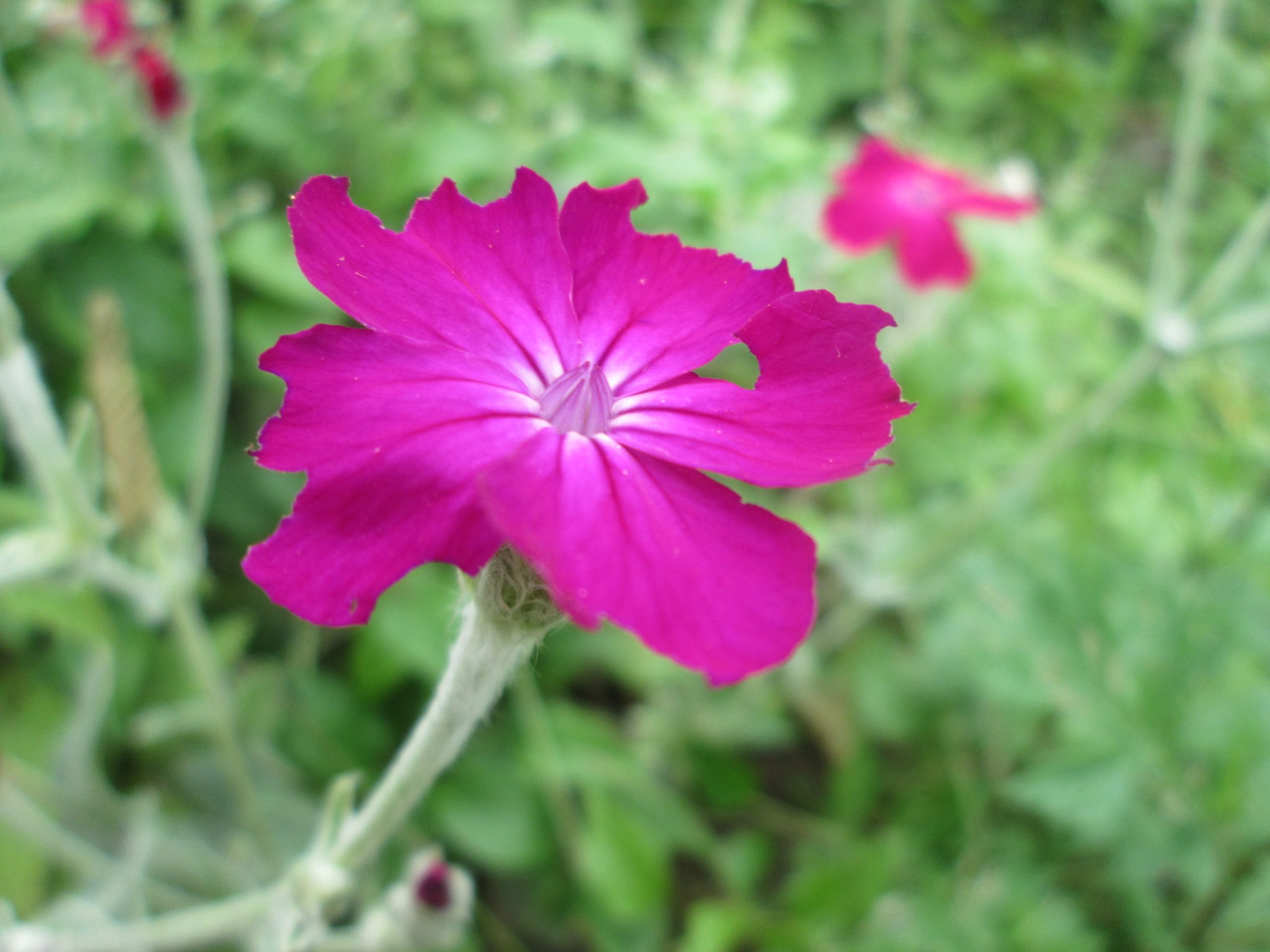
Habit: Perennial herb 30–100 cm tall. Stems: Erect and simple in the lower part, becoming dichotomously branched in the upper portion, where the branches regularly fork to bear the terminal flowers. Leaves: The basal leaves, up to 15 cm long, are obovate-spatulate and arranged in a persistent rosette. The cauline leaves are lanceolate, sessile, and oppositely arranged; they often have connate bases (fused together around the stem) or are amplexicaul. Flowers: Arranged in a few-flowered inflorescence, composed of a small number of solitary flowers borne on long peduncles. The flower, about 2 cm in diameter, is dialypetalous and actinomorphic. The calyx is conical, gamosepalous, and densely villous, marked by 5–10 longitudinal veins. The corolla consists of 5 vivid pink-purple petals, twice as long as the calyx. A distinctive feature is the presence of a paracorolla formed by scales with two sharp bifid teeth that cover the throat (the opening of the flower), creating a small central “crown”. Fruits: A pyriform septicidal capsule opening by 5 apical teeth, releasing numerous reniform, finely tuberculate seeds. Flowering: April–August.
Distribution and habitat
Chorological type: Mediterranean-Turanian. Distribution in Italy: Present in almost all regions of continental Italy, both as a spontaneous species and as an adventive escaped from cultivation. Habitat: It adapts to a wide range of bright environments, such as clearings, cliffs, rocky places, woodland edges, and cultivated fields, up to 1200 m a.s.l.
Etymology
Generic name (Lychnis): From the Greek lýchnos (lamp). The etymology refers to the ancient use of the plant: its leaves and stems, being very tomentose, were dried and rolled to serve as wicks in oil lamps. Specific name (coronaria): From the Latin coronarius (crown-shaped). The name alludes to the crown of scales at the throat of the corolla, but also to the beauty of the flowers, which made them suitable for ceremonial wreaths.
Uses and properties
Rose campion is an extremely popular plant in Mediterranean and xerophilous gardening. It is grown mainly for the elegant chromatic contrast between its silvery, softly undulating foliage and its intense magenta flowers.