The Anise Scent of Highlands
Characteristics
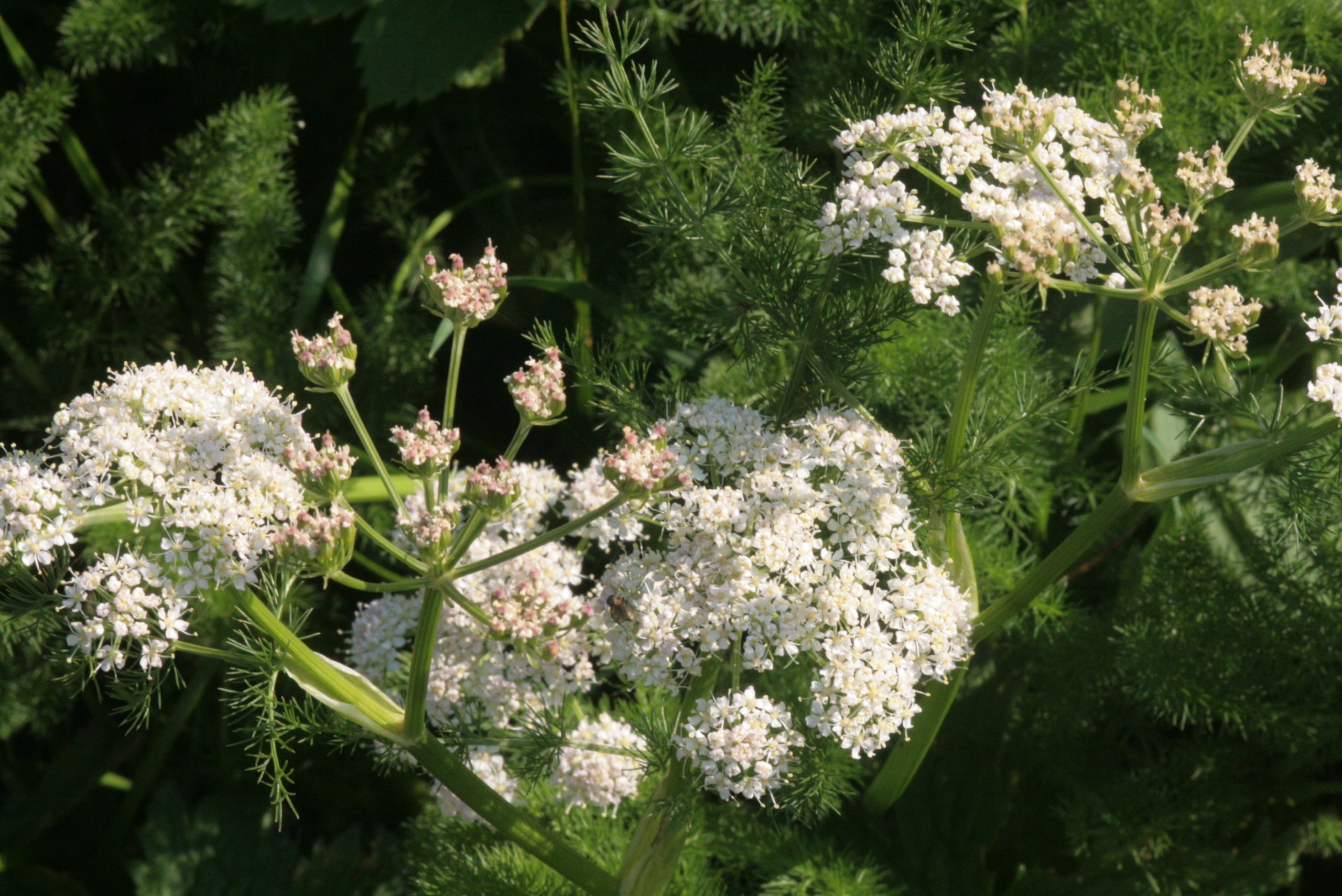
Habit: Slender perennial herb, usually reaching 60 cm in height. Stem: Erect, sparsely branched, with a fistulose structure (hollow inside) and a finely longitudinally striated surface. Root: Woody and robust, whose upper part (crown) is typically wrapped in a dense felt of brown fibres, residues of the leaf sheaths from previous years. Leaves: Triangular in overall outline and up to 25 cm long. The blade is extremely divided into very thin filiform segments, arranged in dense tufts that simulate whorls (pseudowhorls), giving the leaf a feathery and delicate appearance. Flowers: Gathered in an umbel inflorescence, up to 18 cm in diameter and composed of 10–15 main rays. At the base of the umbel, the bracts are few and often deciduous, while the umbellets are supported by 3–5 persistent bracteoles. The flowers are numerous, with small white petals sometimes tinged with purple. Fruits: An ellipsoidal schizocarp about 6 mm long. It is distinguished by prominent, raised primary ribs, which facilitate recognition of the species during fruiting. Flowering: May–August.
Distribution and habitat
Chorological type: Central European orophyte. Distribution in Italy: Present in most of the national territory along the Alpine arc and the Apennine chain. However, it is absent from the major islands (Sicily and Sardinia) and from some regions such as Lombardy, Friuli Venezia Giulia, Campania, Molise, and Puglia. Habitat: It prefers rich pastures and meadows, open ridge areas, and sunny grassy slopes, between 1000 and 2800 m a.s.l.
Etymology
Generic name (Meum): Directly derived from the Latin term meum, used by Pliny the Elder to indicate an aromatic herbaceous plant with similar characteristics. Specific name (athamanticum): Refers to the genus Athamanta, highlighting the morphological resemblance, especially in the foliage, to the species belonging to that botanical group.
Uses and properties
Spignel is highly appreciated in high-altitude pastures because cows that feed on it produce particularly fragrant milk, from which renowned alpine cheeses are made. In the past, its roots were used in folk medicine for their digestive and carminative properties, similarly to other aromatic Apiaceae. Because of its elegance and finely divided foliage, it is occasionally cultivated in rock gardens or alpine-style plantings, where it requires well-drained soils and bright positions.