The Dark Giant of the Mountain Mediterranean
Characteristics
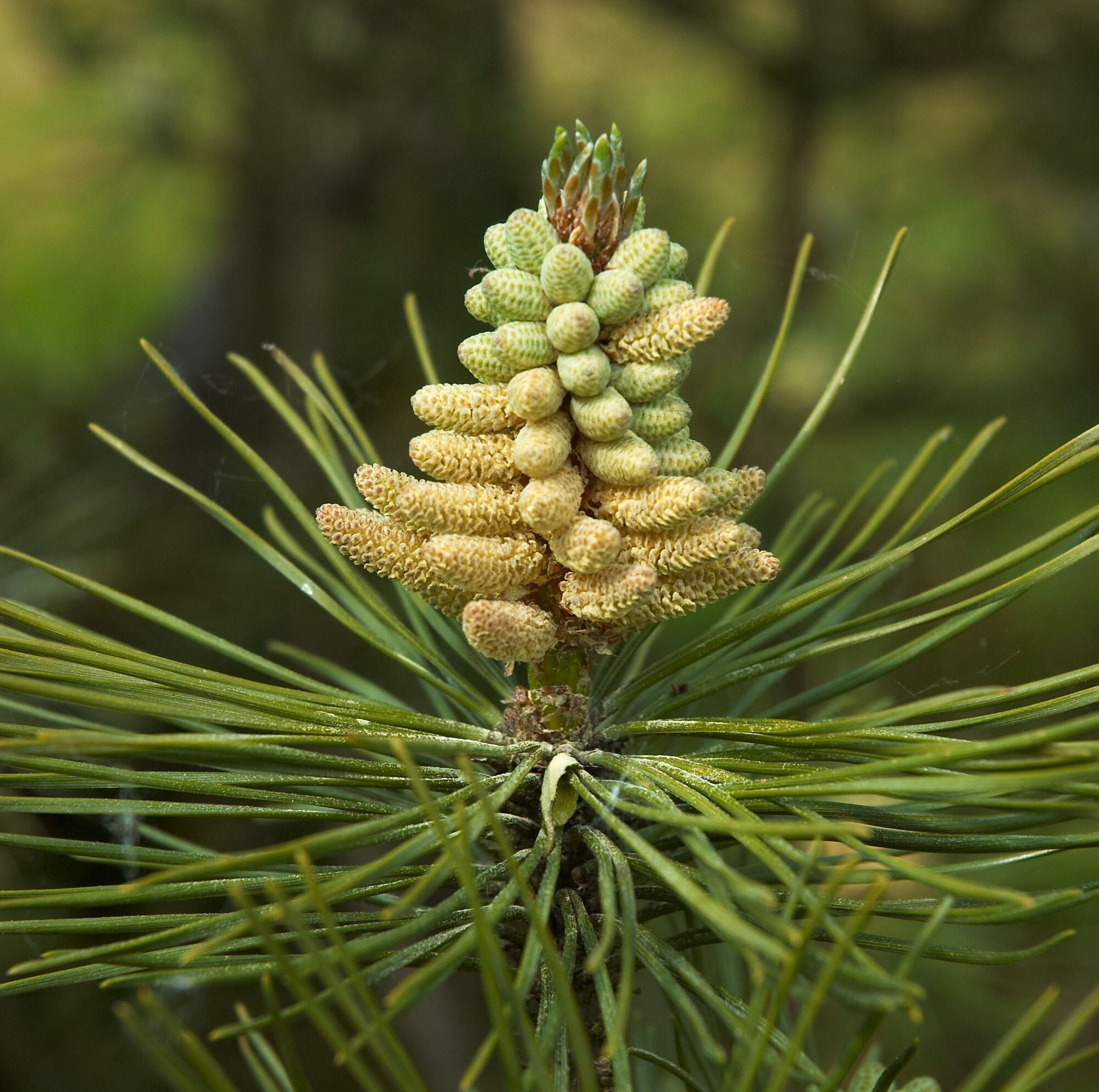
Habit: Large tree reaching average heights of 15–25 metres. The crown, initially pyramidal and regular, becomes expanded and irregular with age. Bark: Brownish-grey and scaly in youth; in mature specimens it splits into broad plates furrowed by dark fissures. Branches: Arranged in conspicuous whorls in young specimens, with a horizontal habit and terminal portions turned upward. The buds are ovoid or cylindric-ovoid, pointed, and rich in resin. A key distinctive feature allows the subspecies to be separated: Corsican pine has slender branches and a light crown, whereas Austrian pine has thick, knotty branches and a dense crown. Leaves: Needle-like and long (8–16 cm), with a persistent sheath at the base. There is a clear structural difference based on rigidity: the subspecies laricio has flexible, scarcely pungent, lighter-coloured needles (thanks to a thin mechanical hypodermis), while the subspecies nigra has more rigid, darker, and sharper needles because of a much thicker hypodermal layer (2–5 layers). Reproductive organs: Male cones are yellow, shaped like small cylinders, grouped at the base of new shoots to release clouds of pollen in spring; female cones are situated at the apex of branches in groups of 2–5, with a characteristic carmine-red colour. The seed cones are 5–8 cm long, mature in the autumn of the second year, and fall the following spring. A unique distinguishing character is the black colour of the inner, hidden side of the scales. Seeds are wedge-shaped and provided with a long wing for wind dispersal. Flowering: April–July.
Distribution and habitat
Chorological type: Montane Mediterranean. Distribution in Italy: Present in scattered stands in the Eastern Alps and the central-southern Apennines. Widely used for reforestation throughout the Apennines. Habitat: A heliophilous (sun-loving) and extremely frugal species, able to adapt to sandy, clayey, or calcareous soils. It is usually found between 900 and 2000 m a.s.l.
Etymology
Generic name (Pinus): Of ancient and debated origin, it may derive from the Sanskrit pitu (resin) or from the Latin pix (pitch), in reference to its abundant resin production. Another theory suggests the Indo-European root pic (to prick), referring to the needles. Specific name (nigra): Derived from the Latin adjective niger meaning “black,” referring to the overall appearance of the crown, which looks very dark green and dense, almost sombre when seen from afar.
Uses and properties
Black pine is one of the most important conifers for the European forest economy. The timber of the subspecies laricio is highly valued for fine carpentry and cabinetmaking thanks to the straightness of its trunks; by contrast, the wood of the subspecies nigra is coarser and used for packaging or low-quality construction. Historically, this species was the protagonist of the great reforestation campaigns of the twentieth century for the consolidation of arid and degraded slopes. Thanks to its rapid growth and ability to improve soil quality, it is used to control landslides and stabilise sandy dunes. In urban settings it is highly appreciated as an ornamental tree in parks and avenues, as it tolerates atmospheric and industrial pollution extremely well. It is also used for Christmas trees, poles, and as excellent firewood.
Curiosities
In Italy two subspecies of black pine occur: Corsican pine (Pinus nigra subsp. laricio), typical of Calabria (Sila, Aspromonte) and Sicily (Etna), recognisable by its exceptionally straight trunk, and Austrian black pine (P. nigra subsp. nigra), widespread in northern and central Italy, Molise, and Campania. Also noteworthy is the variety italica (Villetta Barrea pine), exclusive to Abruzzo.