The Yellow Strength of the Mountains
Characteristics
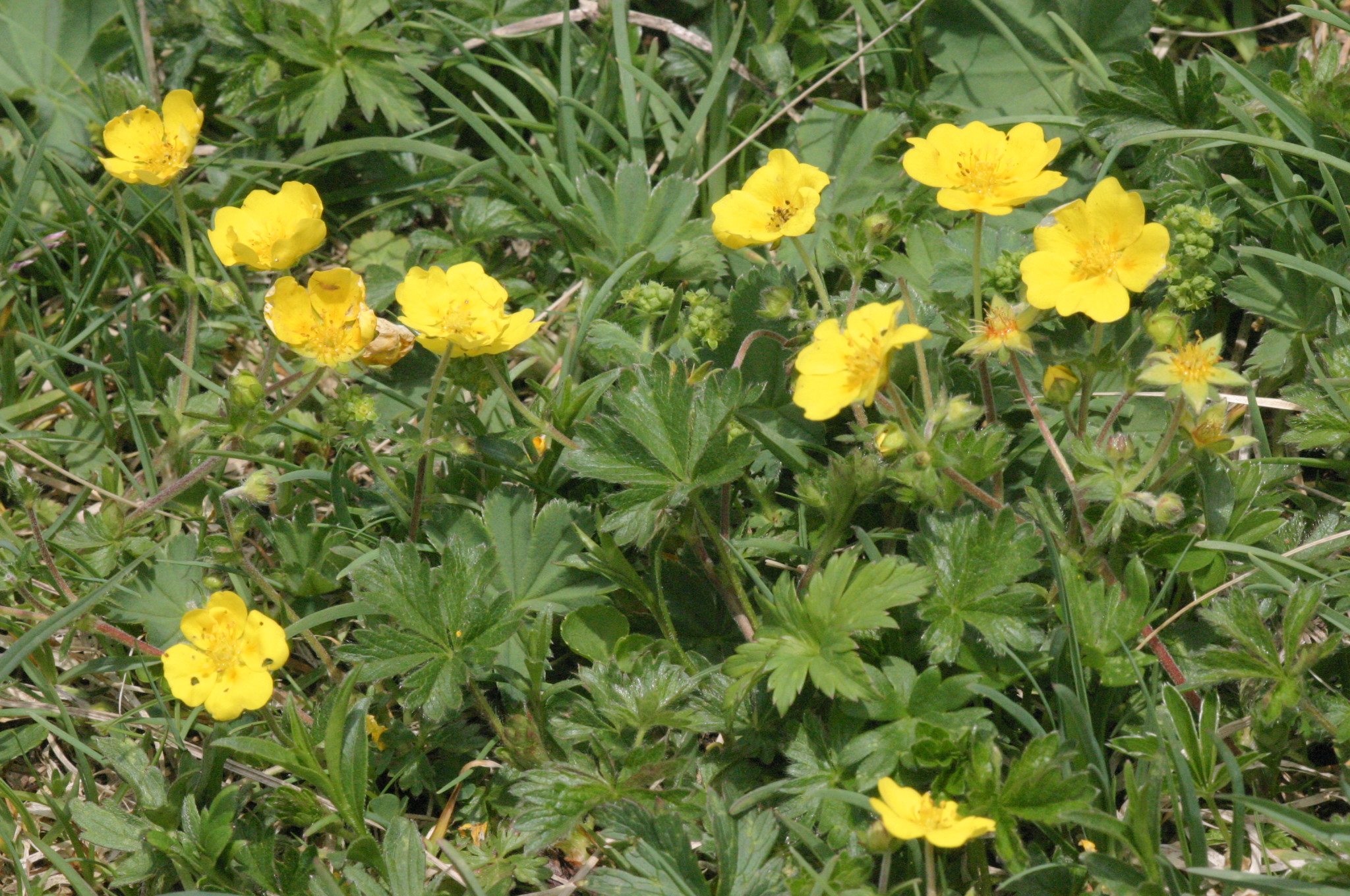
Habit: Perennial herbaceous plant supported by a woody, branched root. Stems: 5 to 20 cm long, ascending, sparsely branched, and slightly woody at the base. The whole structure is characterised by spreading hairs standing open and perpendicular to the surface. Leaves: The basal leaves are composed of 5 (rarely 7) obovate-cuneate segments, narrow at the base and widened toward the apex, where they bear coarse teeth in the upper half. The blade is villous, with hairs especially dense along the margin and veins. The cauline leaves are progressively smaller and reduced to 3–5 segments. Flowers: Gathered in a cyme composed of 2 to 7 flowers. The corolla is formed by 5 intense yellow petals, often with an orange shade at the base, obovate-cordate in shape and bilobed (with a small notch at the apex). The calyx consists of 5 acute sepals, accompanied by an outer epicalyx with slightly smaller segments. Fruits: An aggregate of achenes, which may be smooth or slightly wrinkled depending on maturity. Flowering: May–August.
Distribution and habitat
Chorological type: Circum-Arctic-Alpine. Distribution in Italy: Found on the mountains of almost all continental Italian regions, along the Alpine arc and the Apennine chain. Habitat: It colonises dry alpine and subalpine pastures, rocky slopes, and cliffs, from 1000 up to 3600 m a.s.l.
Etymology
Generic name (Potentilla): Diminutive of the Latin potens (powerful). The name was coined to underline the marked tonic and astringent properties attributed since antiquity to some species of this genus. Specific name (crantzii): Dedicated to Heinrich Johann Nepomuk von Crantz (1722–1799), the renowned Viennese professor and botanist who devoted much of his studies to the classification of Alpine species.
Uses and properties
Crantz’s cinquefoil is considered a medicinal species, whose active parts lie mainly in the root and the whole flowering plant. Thanks to its high content of tannins, resins, and organic acids, it has marked astringent, anti-haemorrhagic, and anti-inflammatory properties. In traditional medicine, decoctions and mouthwashes based on Potentilla are used to treat inflammations of the oral cavity (aphthae, gingivitis) and to promote wound healing thanks to their vulnerary action.
Curiosities
Often, when fruits are absent, these plants are mistaken for wild strawberries because of the similar shape of leaves and flowers. The distinction, however, is clear when observing the receptacle: in strawberries it becomes fleshy and red (false fruit), whereas in Potentilla it remains dry and bears small superficial achenes.