The Soap Herb of the Ancients
Characteristics
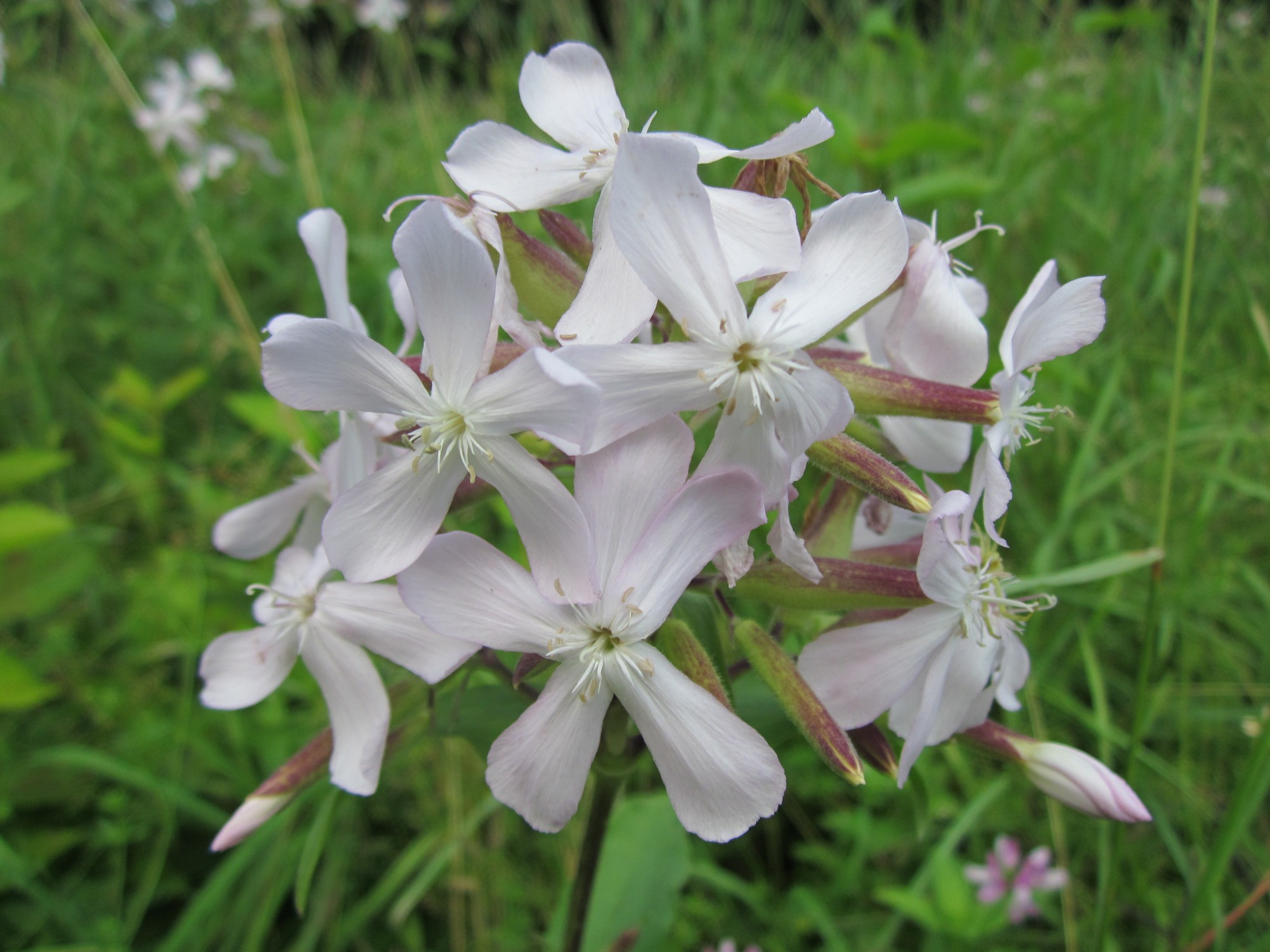
Habit: Perennial herbaceous plant that may reach 1 metre in height. Stems: Erect or ascending, cylindrical, generally glabrous or with very slight pubescence, and may become partly woody at the base in older plants. Leaves: Arranged oppositely along the stem. They are oval or oblong, slightly curved, and bear 3–5 very evident longitudinal veins on the lower surface. Flowers: Gathered in dense cymes at the apex of the stems. They have a tubular calyx, often tinged with violet, and a corolla formed by 5 pink petals, more or less intense in colour, slightly notched at the apex. They emit a delicate fragrance that intensifies during the evening hours to attract nocturnal pollinators. Fruits: An oblong-pyriform capsule that opens at maturity by means of 4 apical teeth. Inside it are numerous small black reniform seeds, whose surface is covered with tiny protuberances. Flowering: May–September.
Distribution and habitat
Chorological type: Eurosiberian. Distribution in Italy: Common and present in all Italian regions. Habitat: It is found along riverbanks, in ruderal habitats, embankments, and anthropised areas. It is frequent near old wool-processing workshops or historical industrial sites, a testimony to its ancient cultivation. It grows from sea level up to 1000 m a.s.l.
Etymology
Generic name (Saponaria): From the Latin sapo (soap), owing to the presence of saponins that, when shaken in water, produce a persistent cleansing foam. Specific name (officinalis): From the Latin officina (workshop), indicating its historical use in pharmaceutical and herbal preparations.
Uses and properties
Common soapwort is a toxic medicinal species because of its high content of saponins, which have a strongly irritating effect on the mucous membranes and digestive tract; for this reason, internal use has now been almost completely abandoned. In the past it was used for its depurative, sudorific, and expectorant properties in cases of gout or chronic bronchitis. Hippocrates cited it as a depurative, while Arab physicians employed it in the treatment of leprosy and, in the seventeenth century, it was proposed as a remedy against syphilis. Since the eighth century BC, the Assyrians used it as soap. For centuries it was the detergent of choice for degreasing the wool of carpets in Asia and for washing delicate fabrics such as silk and precious lace before the advent of synthetic products. Even today, its decoction is considered one of the best remedies for cleaning and restoring brilliance to ancient textiles in museum conservation. In dermatology, soapwort compresses may be useful for acne and psoriasis, but extreme caution is necessary, as contact with the eyes may cause severe irritation.