The Purple Spike of the Underwood
Characteristics
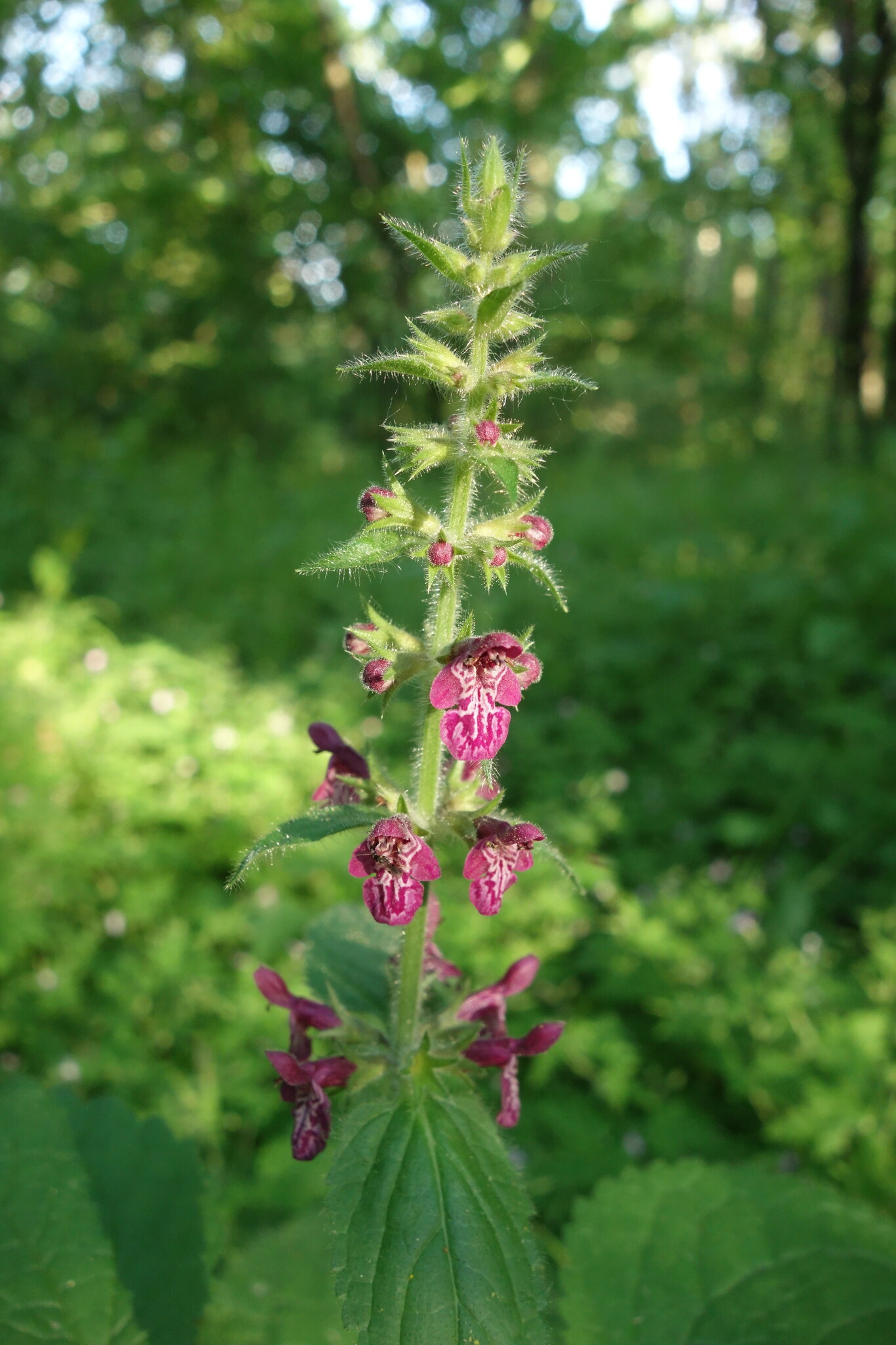
Habit: Stoloniferous perennial herbaceous plant, 30–100 cm tall, without a basal rosette. Stem: Quadrangular in section, erect, sticky, and covered with soft hairs directed downward. Leaves: The lower leaves have a long petiole, 4–6 cm, and an ovate-cordate blade, pointed and with a serrated margin. They emit a strong, sometimes unpleasant smell when rubbed. The upper ones become progressively smaller, sessile, and lanceolate in shape. Flowers: Gathered in a terminal spike composed of verticillasters, groups of flowers arranged in rings around the stem, spaced apart from each other. Each verticillaster contains 3–6 flowers. The corolla is bilabiate, of a dark purple colour with characteristic white streaks or spots on the lower lip. The two lips are clearly divergent. Fruits: A microbasarium composed of 4 subtriangular nutlets, wrinkled and brown at maturity. Flowering: May–August.
Distribution and habitat
Chorological type: Eurosiberian. Distribution in Italy: Present in all Italian regions except Sardinia. Habitat: It prefers cool, shady environments rich in organic matter, in moist ravines and along woodland path margins, from the lowlands up to 2000 m a.s.l.
Etymology
Generic name (Stachys): From the Greek stakhys, meaning ear or spike, referring to the arrangement of the flowers along the flowering axis. Specific name (sylvatica): From the Latin sylva, meaning woodland or forest, clearly indicating its preferred habitat.
Uses and properties
Wood betony is a medicinal species used since antiquity. Traditionally employed for its antispasmodic, sedative, and diuretic virtues. It is also known as an emmenagogue plant, capable of stimulating menstrual flow. An extract obtained from the plant is used to dye textiles a delicate yellow colour.
Curiosities
In many Italian regions it is known as “herb of fear.” According to folk medicine, it was used to treat fright, states of anxiety or shock. The flowering tops were boiled and the resulting water was used for washings or sponging. It was believed that the essential oils, absorbed or inhaled, could calm excess adrenaline and “wash away” accumulated fear.