The Balsamic Guardian
Characteristics
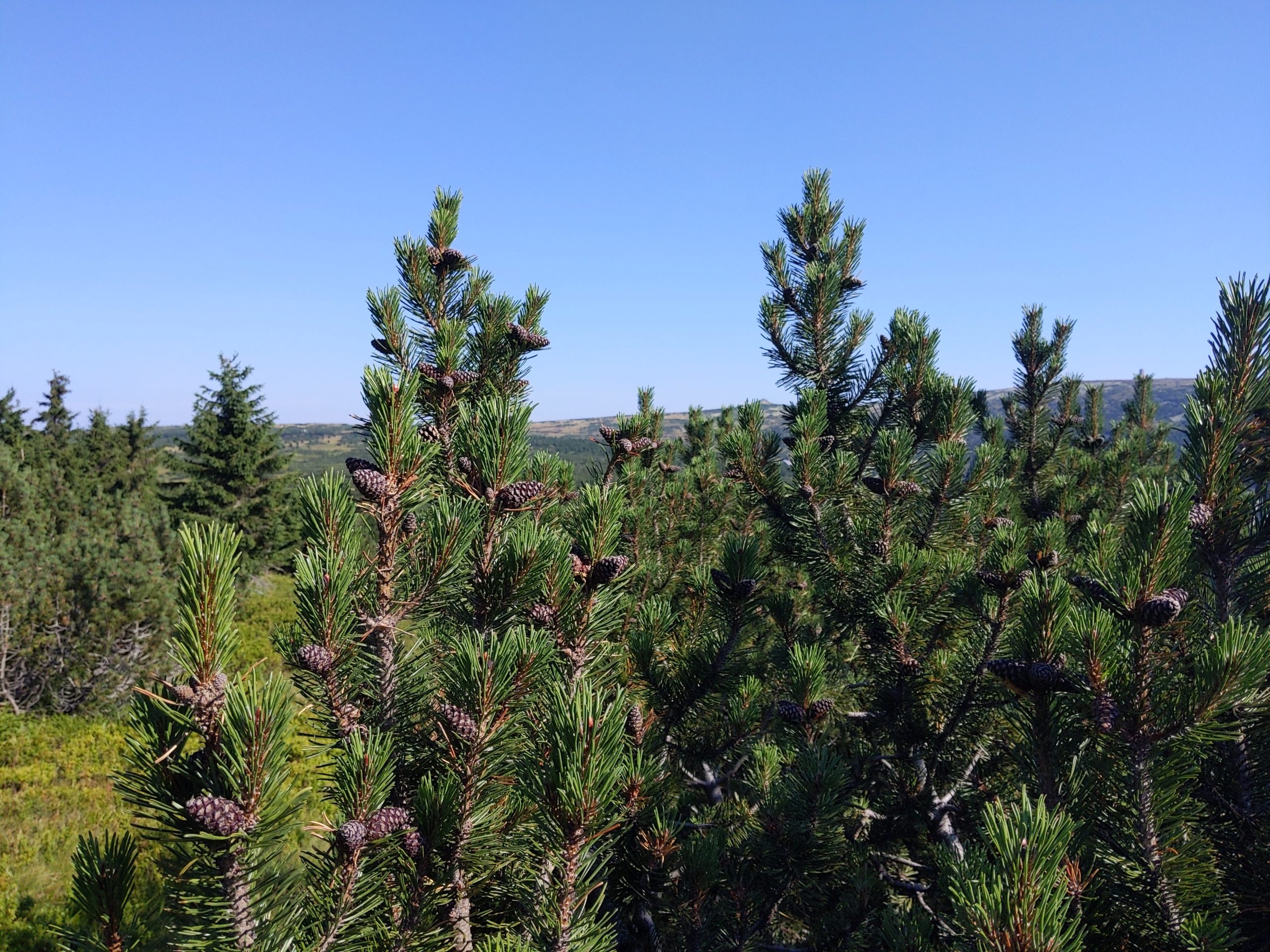
Habit: Bushy shrub, 2 to 5 metres tall. Branches: Prostrate, tending to become ascending toward the apex. Stem: Erect and surrounded by prostrate secondary stems. Bark: Initially smooth and grey-brown, becoming scaly with age. Leaves: Needle-like, robust, pungent, and slightly twisted, 28–45 mm long. They are grouped in pairs and have a dark green colour with finely toothed margins. They are remarkably long-lived, persisting on the branches for 3 to 9 years. Reproductive organs: Male cones are yellow, oblong, pollen-bearing, and grouped at the base of young branchlets; female cones are purplish, solitary or paired (1–2), in terminal position. The seed cones are conical-ovoid (3–5 cm), almost sessile, solitary or in clusters, with scales marked by a characteristic central umbo. Maturation occurs during the third year, releasing small dark seeds provided with a wing for wind dispersal. Flowering: April–July.
Distribution and habitat
Chorological type: Eurasian orophyte. Distribution in Italy: Common throughout the Alpine arc; in the Apennines it is significantly present especially in the Abruzzo massifs. Habitat: A pioneer and extremely hardy species, capable of colonising unstable slopes and partially consolidated debris soils. It grows between 1500 and 2300 m a.s.l., often forming dense primary thickets (mugo pine scrub).
Etymology
Generic name (Pinus): Of ancient and debated origin, it may derive from the Sanskrit pitu (resin) or from the Latin pix (pitch), in reference to its abundant resin production. Another theory suggests the Indo-European root pic (to prick), referring to the needles. Specific name (mugo): Derived from the Old French musguét (musk), itself from the Arabic musk, a term that originally referred to a ruminant with a scent gland, recalling the plant’s intense aromatic fragrance.
Uses and properties
Mountain pine is a plant of primary medicinal importance for Alpine communities. From the distillation of its twigs and needles is obtained the celebrated mugolio, an essential oil with marked balsamic, anti-inflammatory, and expectorant properties, fundamental for treating coughs, asthma, and bronchial ailments. For external use, the essence is an excellent antiseptic and is employed in liniments to relieve bruises and muscle strains. In food traditions, the buds macerated in the sun with sugar produce a syrup used to flavour grappas and digestive liqueurs. The yellow-reddish wood is hard and elastic; although its small dimensions prevent its use in construction, it has historically been employed for making kitchen utensils, barrel hoops, and as an excellent fuel. Owing to its graceful appearance and slow growth, it is also highly appreciated as an ornamental plant in rock gardens.