The Velvet of Meadows
Characteristics
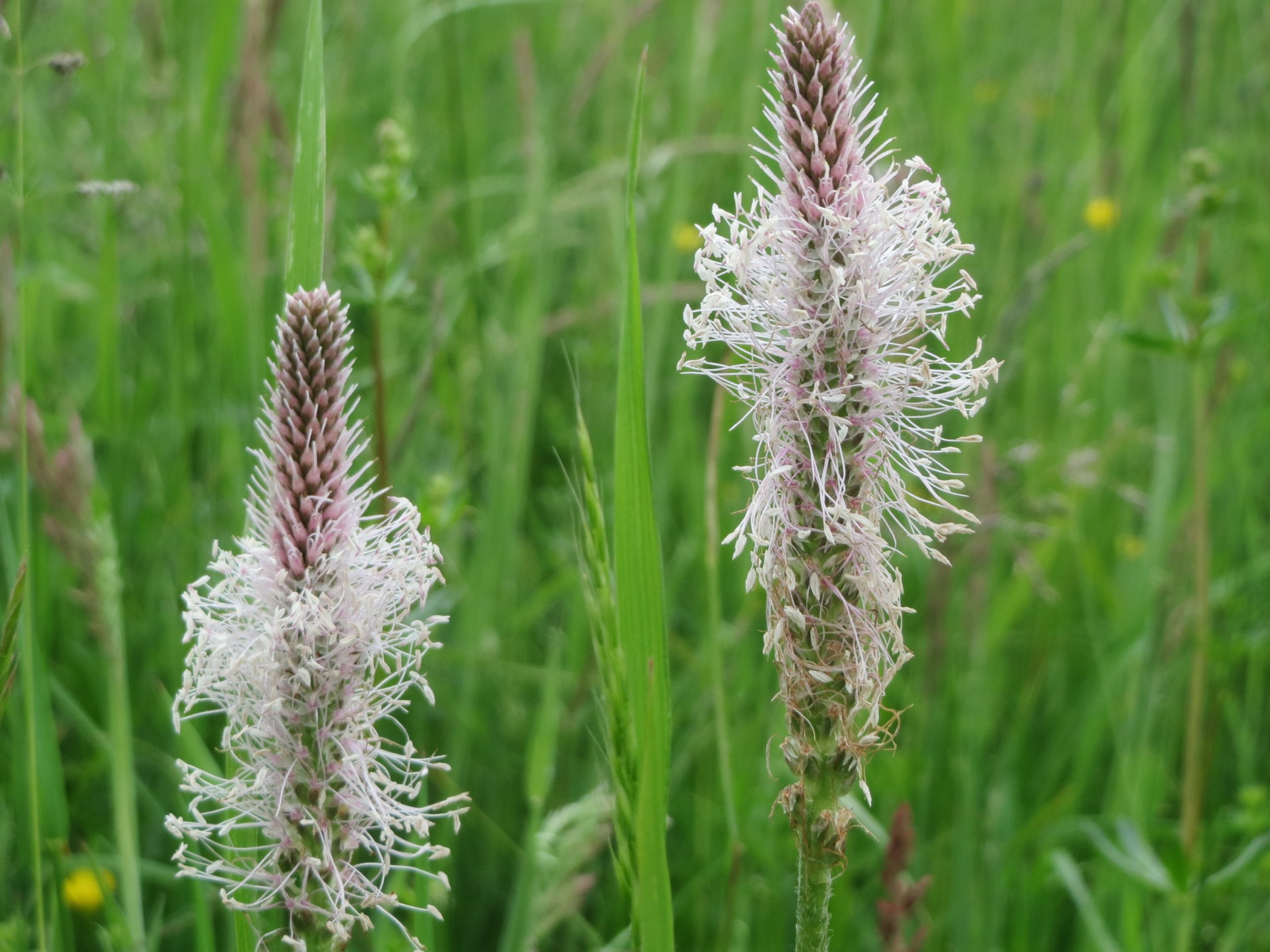
Habit: Perennial herbaceous plant developing a basal rosette densely appressed to the ground, from which an erect or slightly curved flowering scape emerges, 10–40 cm tall. Leaves: All basal, elliptic with an obtuse apex and an entire or sparsely toothed margin. They are traversed by 5–9 very marked parallel veins and have a velvety texture. The petiole is short, winged, and densely pubescent. Flowers: Gathered in a terminal cylindrical spike, initially 2–6 cm long, which tends to elongate considerably during fruiting up to 15 cm. The corolla is divided into 4 obtuse lobes, from which long pinkish or violet staminal filaments emerge, with whitish-yellow anthers, giving the spike a feathery appearance. The calyx is composed of 4 glabrous oval sepals, while the ovary is round and green with a characteristic red style. Fruits: An ovoid pyxidium (capsule opening transversely), containing 2 to 7 plano-convex seeds. Flowering: April–August.
Distribution and habitat
Chorological type: Eurasian. Distribution in Italy: Present throughout the national territory, except for the major islands. Habitat: It grows preferably in rather dry meadows, pastures, roadsides, and uncultivated ground, from the lowlands up to 2000 m a.s.l.
Etymology
Generic name (Plantago): From the Latin planta (sole of the foot), both because of the leaf shape in some related species and because of the notable resistance to trampling that allows these plants to thrive in areas frequented by human or animal passage. Specific name (media): From the Latin medius (intermediate), indicating a size intermediate between other similar species such as P. major and P. lanceolata.
Uses and properties
Hoary plantain is a versatile medicinal and edible species. Thanks to its richness in mucilages, tannins, and aucubin, it has astringent, anti-inflammatory, haemostatic, and healing properties. In folk medicine, the leaf infusion is used for gargles, mouth rinses, and eye compresses, while the macerated fresh leaves are an immediate remedy to soothe insect bites or promote the healing of sores and ulcers. A syrup made from the plant is considered an effective remedy for cough and hoarseness. In culinary use, the youngest leaves can be eaten raw in salads or cooked with other wild herbs in savoury pies and fillings; their cooking also naturally dyes dishes green. On an industrial level, the seeds are used in the production of dressings and as thickeners in paper-polishing processes.