The Bear’s Ear
Characteristics
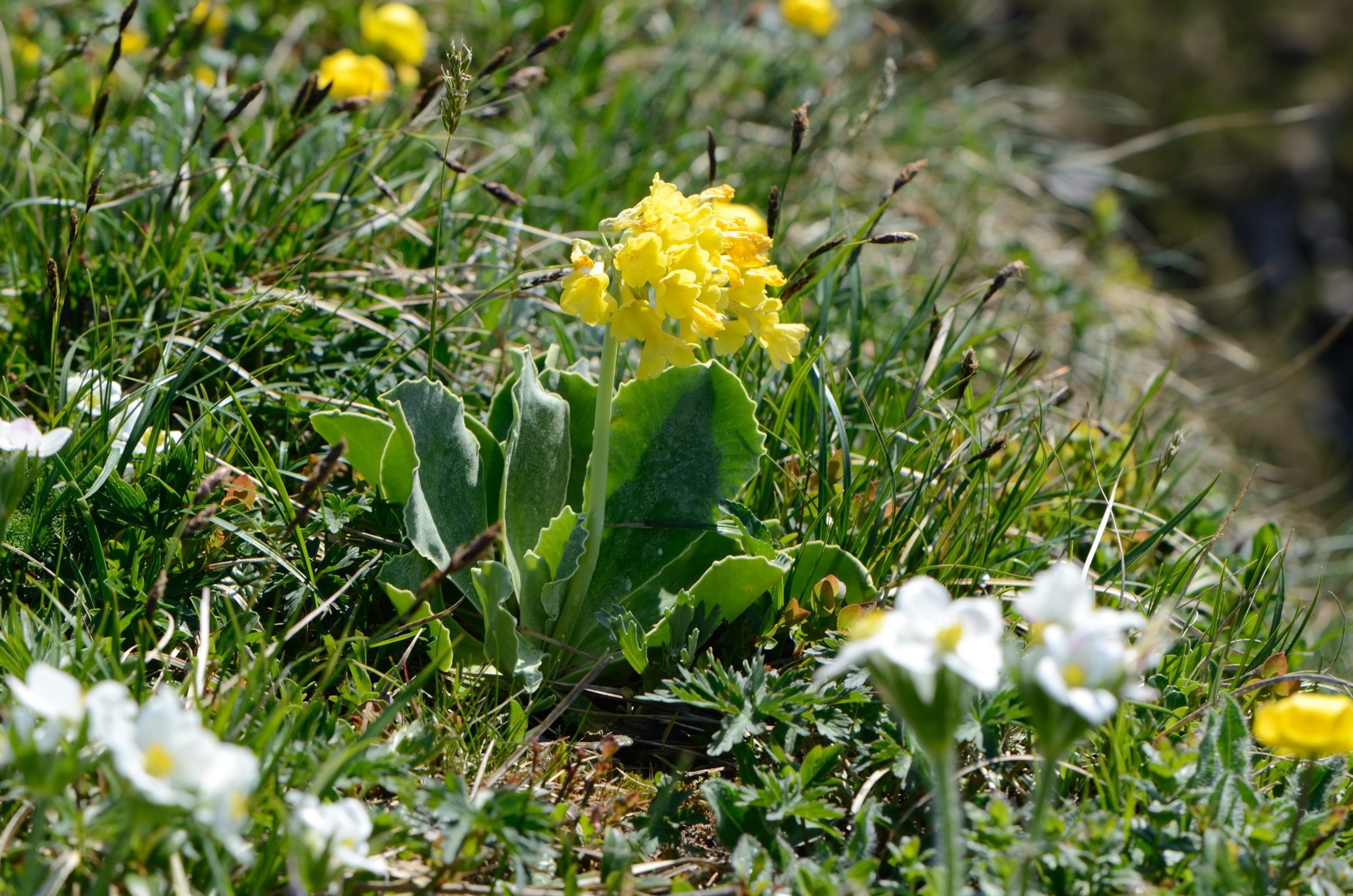
Habit: Robust perennial herbaceous plant with a flowering scape 5 to 25 cm tall. Leaves: Exclusively basal and gathered in a dense rosette. The blade is obovate-spatulate or almost circular; its texture is fleshy and leathery. The surface is often glossy, sometimes mealy, with a margin that may be entire or toothed toward the apex. Flowers: Gathered in an umbel at the apex of the scape, composed of a variable number of flowers (2 to 25) borne on peduncles. The calyx is campanulate and appears mealy. The corolla, bright yellow with a white-mealy throat, is funnel-shaped and showy (15–25 mm in diameter), with lobes that may be entire or heart-shaped. Fruits: A globose capsule provided with a small point (mucronate). At maturity, the capsule opens by 5 teeth to release the seeds. Flowering: April–July.
Distribution and habitat
Chorological type: Southern European orophyte. Distribution in Italy: Present in almost the whole Centre-North (except Valle d’Aosta, Piedmont, and Liguria) and along the Apennine chain down to Campania. Habitat: A rupicolous plant that prefers crevices in rock walls, cliffs (especially calcareous and dolomitic), and sunny stony pastures. It occurs within a wide altitudinal range, from 300 m up to 2900 m a.s.l.
Etymology
Generic name (Primula): From the Latin primus (first), a term celebrating the precocity of flowering in this genus, which often announces the end of winter. Specific name (auricula): From the Latin auricula (small ear), in direct reference to the morphology of the fleshy, rounded leaves.
Uses and properties
Considered a medicinal species; like other primroses, it contains active principles with analgesic, anti-inflammatory, and antitussive properties, useful in the treatment of coughs and inflammations of the respiratory tract. Today, however, its main use is ornamental: the beauty of its flowers and the peculiarity of its foliage have led to the selection of numerous horticultural varieties (cultivars) with bright colours, highly appreciated in alpine gardening and as pot plants. Its image is so iconic that it has often been used as an alpine symbol on coins and stamps.