The Thorny Queen
Characteristics
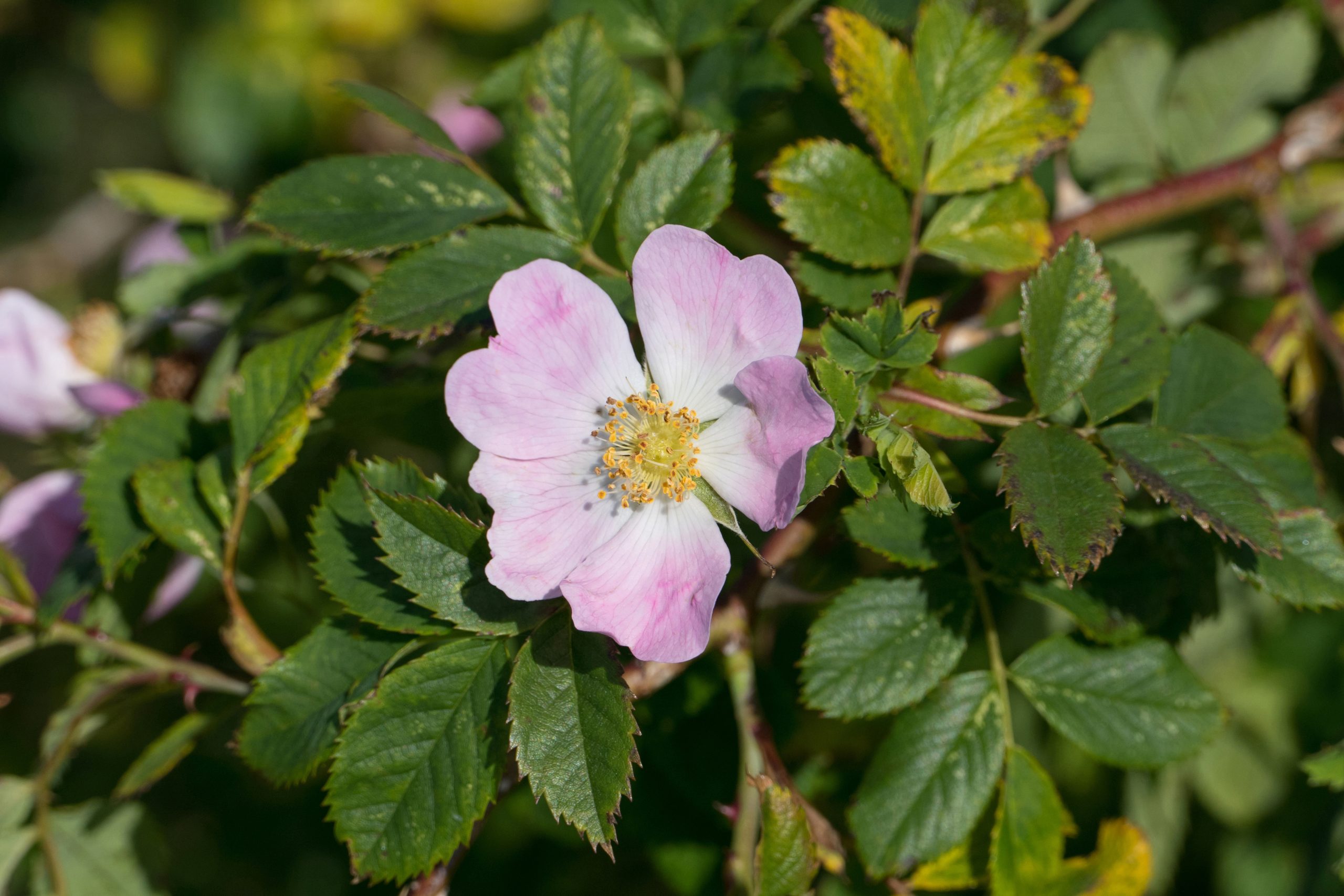
Habit: Deciduous woody shrub, 1–3 m tall. Stems: The main stems are robust, while the secondary ones are green. The whole plant is armed with large, recurved hook-shaped prickles with a noticeably enlarged base, allowing the shrub to cling to surrounding vegetation. Leaves: Odd-pinnate, usually composed of 5–7 leaflets (2–3 pairs plus a terminal one). The leaflets are light green, oval or elliptical, with a pointed apex and serrated margins. The surface is glabrous, although slight hairiness may occur along the central rachis. Flowers: Solitary or gathered in small groups of 2–3 on smooth peduncles. They consist of 5 sepals and 5 broad white or pinkish petals, delicately scented. A distinctive feature is the structure of the receptacle: the sepals are fused at the base, forming a cup that encloses numerous ovaries. Fruits: What is commonly called the fruit is actually a fleshy false fruit called a hip. At maturity, in autumn, it becomes pear-shaped or globose and bright red. Inside the pulp are the true fruits: numerous hard, yellowish achenes covered with dense, stiff, irritating hairs. Flowering: March–July.
Distribution and habitat
Chorological type: Palaeotemperate. Distribution in Italy: Widespread throughout the national territory, from coastal areas to the mountains. Habitat: It colonises woodland margins, hedges, degraded thickets, and uncultivated pastures, from sea level up to 1900 m a.s.l.
Etymology
Generic name (Rosa): From the Latin rosa, in turn linked to the Greek rhódon. Specific name (canina): Translation of the Greek term Kynosbator (kynos = dog, batos = bramble). The epithet is linked to the ancient belief, also reported by Pliny the Elder, that the root of this plant was effective in curing rabies transmitted by dog bites.
Uses and properties
Dog rose is one of the most important medicinal species in our latitudes. The hips are renowned for their very high Vitamin C content (up to 50–100 times higher than citrus fruits), as well as bioflavonoids, Vitamin E, and tannins. These components confer tonic, anti-inflammatory, and vasoprotective properties. In herbal medicine, rose hip extracts are used against influenza and gastritis, while the petals are used in astringent infusions for sore throat. In cooking, the fruits, once deprived of seeds and internal hairs, are used to produce excellent jams, jellies, and liqueurs, especially when harvested after the first winter frosts, which sweeten the pulp. In cosmetics, the fresh pulp is an ingredient in beauty masks for its brightening and smoothing action on the skin. Thanks to its hardiness and the resistance of its root system, wild Rosa canina has for centuries been the rootstock of choice for almost all cultivated and ornamental rose varieties.