The Velvety Crown of Pioneer Woods
Characteristics
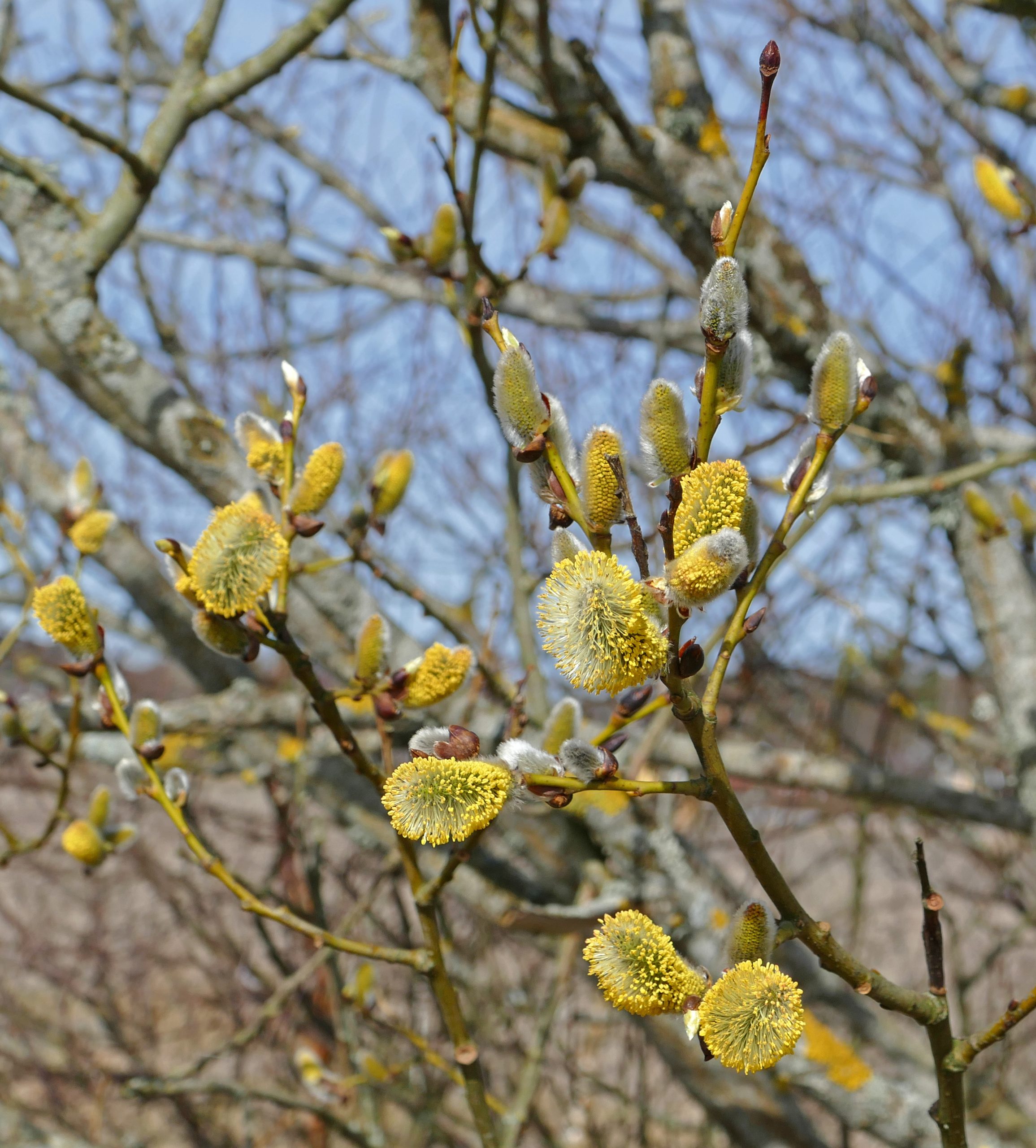
Habit: Shrub branched from the base (2–6 m) or small tree that may exceed 12 metres in height. Bark: Initially smooth and grey-green, it becomes dark grey with age and deeply fissured into characteristic rhomboidal plates. Leaves: Alternate, oval or elliptical, with an acute apex. The upper surface is dull green, wrinkled, and hairless, while the lower one is persistently tomentose and velvety, sage green or whitish, with very evident and prominent secondary veins. The margin may be entire or irregularly toothed. Flowers: Like all willows, it is a dioecious species, with male and female flowers borne on separate individuals. The catkins appear very early, before the leaves. Male catkins are ovoid, erect, and highly decorative because of their golden-yellow pollen-laden anthers. Female catkins are cylindrical, longer (up to 8 cm), initially erect and later reflexed, composed of green ovaries. Fruits: A small elongated capsule, grey-green in colour, which opens at maturity to release tiny seeds. Each seed bears a white feathery pappus that allows wind dispersal. Flowering: February–June.
Distribution and habitat
Chorological type: Eurasian. Distribution in Italy: Present throughout the Alpine arc and along the whole Apennine chain. Habitat: It behaves as a pioneer species, capable of rapidly colonising clearings and bare soils. Although typical of riparian formations (near watercourses), it tolerates drier soils than other willows. It grows from the lowlands up to 1600 m a.s.l.
Etymology
Generic name (Salix): Probably derived from the ancient Celtic sal (near) and lis (water), indicating the ecological link of most species of this genus with aquatic environments. Specific name (caprea): From the Latin caprea (goat), a term introduced by Linnaeus to emphasise how much the leaves and young shoots of this plant are relished and sought after by goats.
Uses and properties
Goat willow is a medicinal species of great historical and phytotherapeutic importance. Its bark is rich in salicin (the natural precursor of acetylsalicylic acid), as well as tannins and resins. Thanks to these active principles, it has marked febrifuge, antirheumatic, tonic, and astringent properties. In the past, bark decoctions were used as an effective remedy against flu-like conditions and joint pain. The young flexible branches (withies) have long been used in agriculture as vine ties or for making baskets, mats, and rustic furniture, thanks to their extraordinary resistance and pliability. Moreover, being one of the first plants to flower at the end of winter, it represents a fundamental nectar source for bees upon their spring awakening.