The Silver Veil of Oak Woods
Characteristics
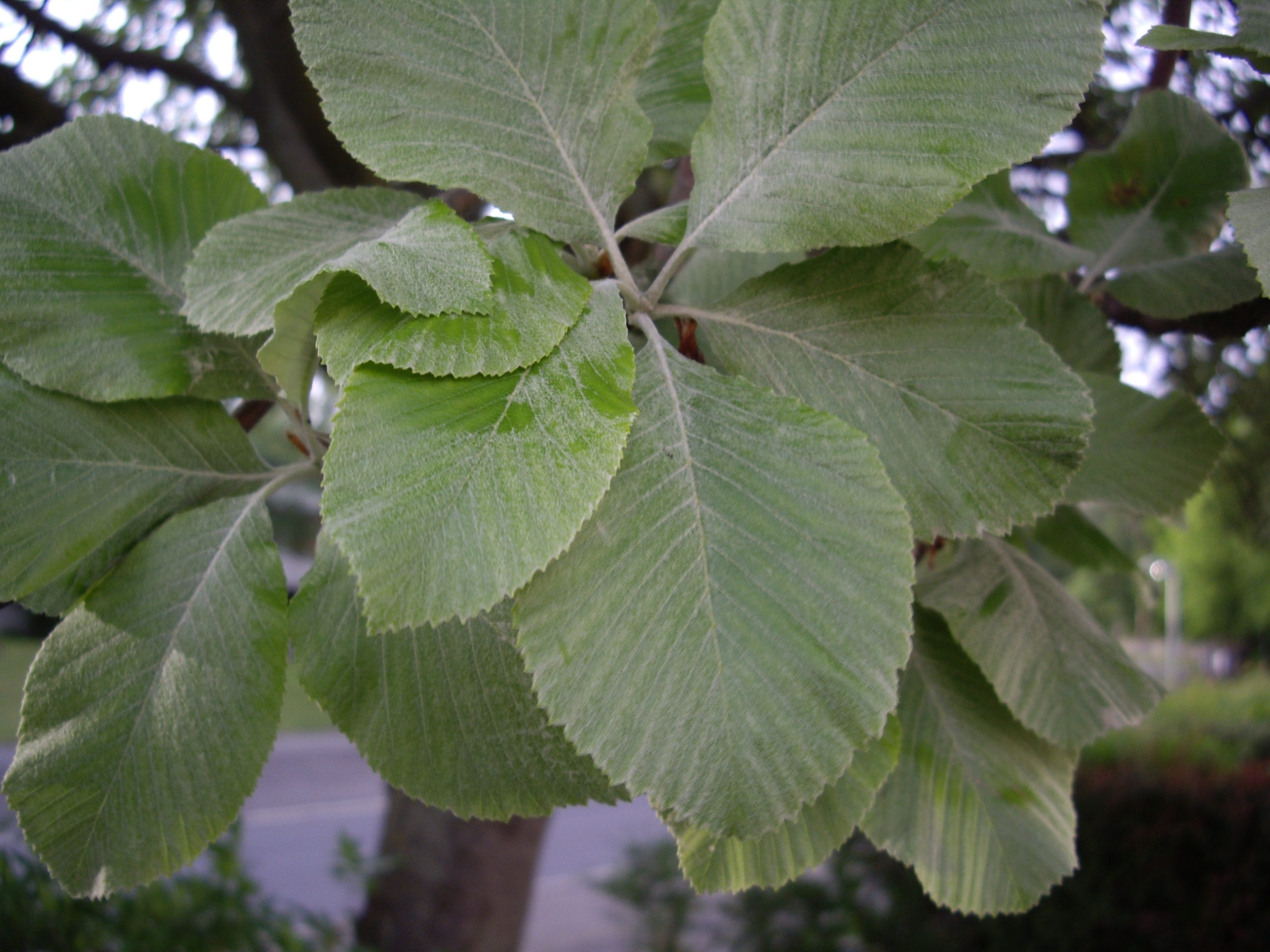
Habit: Shrub or small tree up to 15–16 m tall, with an oval and dense crown. Stem: Erect and cylindrical. Bark: Initially grey-reddish with horizontal lenticels, becoming longitudinally fissured in mature specimens. Branches: The current-year twigs are distinctly covered with a dense white felt. Leaves: Simple and alternate, predominantly oval in shape with an irregularly and doubly serrated margin. The chromatic contrast is the most distinctive feature: the upper surface is deep green and glossy, while the lower one is covered with a dense greyish-white tomentum, velvety to the touch, which gives the crown a silvery appearance when stirred by the wind. Flowers: Hermaphroditic and grouped in large erect corymbs, themselves characterised by diffuse snowy tomentosity. Each flower has a tomentose calyx and 5 white petals. Fruits: A pome, a false berry, oval or subglobose in shape, bright red at maturity and dotted with small pale lenticels. The pulp is yellowish, mealy in consistency and edible, and usually contains 2 seeds. Flowering: April–June.
Distribution and habitat
Chorological type: Palaeotemperate. Distribution in Italy: Common throughout the national territory. Habitat: A heliophilous species that grows on sunny slopes, cliffs, and calcareous debris, up to 2000 m a.s.l.
Etymology
Generic name (Sorbus): From the Latin sorbére (to swallow, to sip), in reference to the edibility of the fruits. Specific name (aria): According to Linnaeus’s hypothesis, the term would refer to a region of western Asia, Ariana, although the species is typically European.
Uses and properties
Whitebeam is a versatile edible and medicinal species. The fruits, rich in sugars, organic acids such as citric and malic acid, and tannins, are harvested after the first frosts to prepare jams, jellies, and syrups with an acidic flavour. Thanks to their high tannin content, the fruits have an astringent action useful in intestinal disorders. In the past, decoctions were also employed as a mild remedy for inflammations of the bronchial tract. The wood is very valuable: hard, compact, and heavy, reddish-brown with ivory-coloured sapwood. Historically, it has been used for the construction of farm carts, tool handles, and small cabinetmaking works requiring resistance to wear.