The history of the Garden is long and complex, marked by ambitious plans as well as periods of difficulty. The first official document, discovered in the municipal archives, dates back to 1957 and records the minutes of a meeting dedicated to the creation of an “Apennine garden and a medicinal plant garden” covering an area of as much as 70 hectares.
The initiative was promoted by the Provincial Tourism Board of Campobasso (at the time, the Province of Isernia had not yet been established), together with the Municipality of Capracotta, with technical support from the Departmental Forestry Inspectorate of Campobasso.
In 1963, the foundation stone was laid. The objectives were ambitious: to enhance the tourist appeal of an area of remarkable beauty while at the same time promoting the cultivation and economic use of medicinal plants.
In 1965, the Ministry of Tourism allocated 800,000 lire for the operation of the Garden.
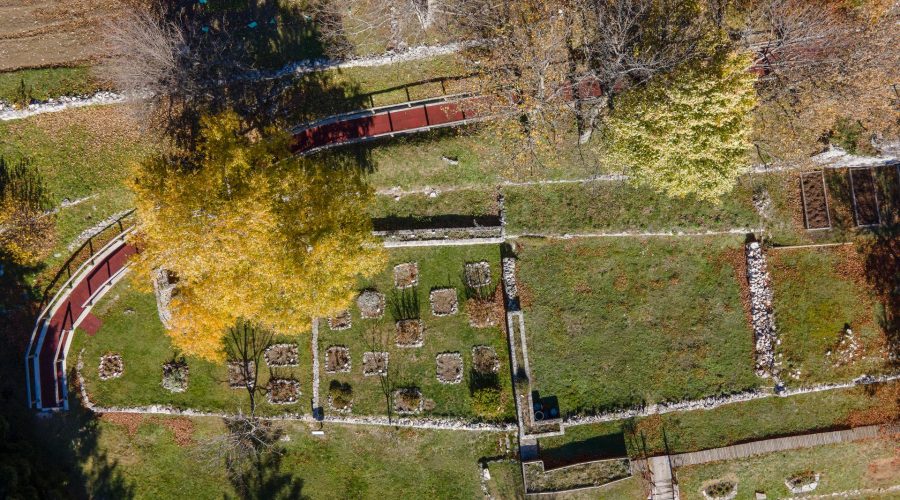
The management was entrusted to the Institute of Botany of the University of Naples, represented by Aldo Merola of the Experimental Station for Medicinal Plants, and Paolo Pizzolongo, director of the Botanical Garden of Naples and originally from Larino (CB). Under their supervision, experimental cultivations were established on specially designed terraces, yielding excellent results.
In 1970, Etaliano Bontempo documented the presence of numerous medicinal plant species cultivated in the Garden, including Angelica archangelica L., Artemisia absinthium L., Anthemis nobilis L., Gentiana spp., Hyssopus officinalis L., Lavandula officinalis Chaix, Mentha spp., Salvia spp., Thymus vulgaris L., Valeriana officinalis L., and many others (Apennine flora and medicinal plants in the Garden of Capracotta in Alto Molise, in «L’Italia Agricola», 1972). However, in that same year, a telegram preserved in the municipal archives, sent by the gardener Antonio Caiazzo, a collaborator of Merola, reported the growing state of neglect of the Garden, which thus entered a long period of inactivity.
The revival came in 1997, when activities related to the design of pathways, cultivation, conservation and research resumed. During this phase, alongside the Municipality of Capracotta, the University of Molise consistently took part, initially with a scientific advisory role and later as a partner in direct management, through the role of Director and Scientific Coordinator.
In 2003, the Municipality of Capracotta and the University of Molise established the Consortium of the Garden of Apennine Flora, adopting its first statute. Subsequently, the Molise Region, the Province of Isernia and the “Alto Molise” Mountain Community of Agnone joined the Consortium (in 2015, the Province of Isernia and the Mountain Community of Agnone withdrew as a result of Law No. 190/2014).
Today, the Garden is a recognized, valued and vibrant place once again: above all, it is a project in constant evolution. Its history shows that the strongest roots withstand the test of time and, like mountain plants, are able to bloom again even after the harshest seasons.